S/4HANA and Data Migration
Since the launch of its S/4HANA suite, SAP has provided a new tool for data migration, the SAP Migration Cockpit. Initially, this tool was designed to assist users in their migration to SAP S/4HANA Cloud Edition. In a Greenfield context towards the cloud edition, the SAP Migration Cockpit is the only migration tool available.
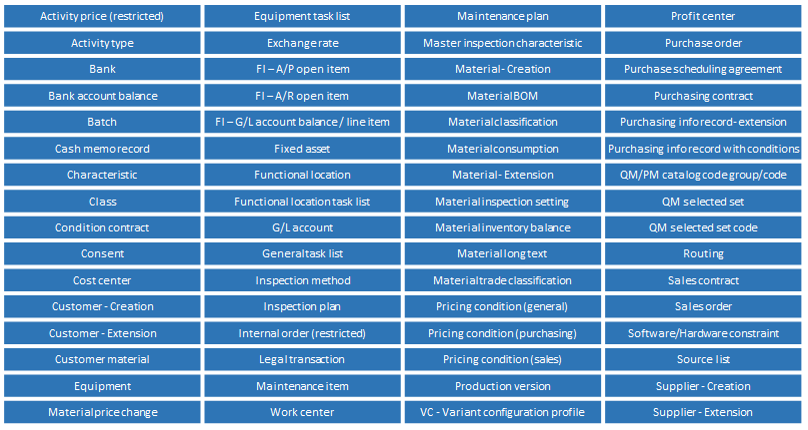
However, SAP has continued to enhance the functionalities of this tool, so much so that since the release of S/4HANA version 1610, users who choose the On-Premise edition can also benefit from it. And for good reason, this Migration Cockpit, whose transaction code is LTMC, will eventually completely replace the historical tool for data transfer, LSMW (Legacy System Migration Workbench). With each update, it allows for the migration of an increasingly wide range of data. The table below lists the data currently covered by the tool (S/4HANA 1809):
1- Data Migration, Fiori Style
What’s new? First, the Migration Cockpit is entirely based on the new Fiori user interface, the flagship of the S/4HANA suite.
From an ergonomic point of view, it must be admitted that this new tool lives up to its name “cockpit”. The Fiori screens are full of indicators of all kinds; they offer a complete panel of different progress statuses for migration projects, progress bars for each program execution, each migration object is associated with rather useful documentation (business rules, dependencies on other migration objects…), and all of this is quite user-friendly. This is a significant improvement compared to LSMW, whose “aged” interface was, to say the least, lacking in information.
From a technical point of view, it should be noted that these Fiori screens are only accessible via a web browser. Consequently, users of the On-Premise version of S/4HANA will need the necessary infrastructure to access the Migration Cockpit. Otherwise, they will have to revert to LSMW, which remains usable in S/4HANA but is no longer maintained by SAP.
But the innovations of this Cockpit are not only ergonomic; they also have a real methodological appeal.
2- Simplified and Streamlined Data Transfer
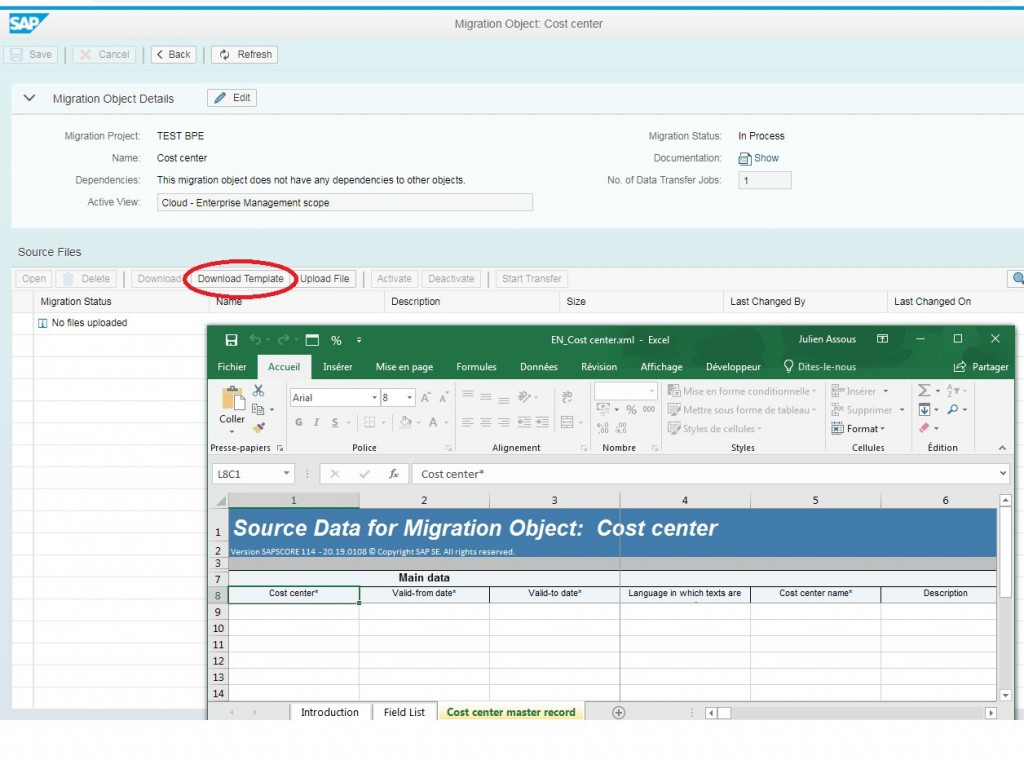
The Migration Cockpit effectively limits the risk of error through various natively operated controls. Now, data transfer templates (spreadsheets where data to be created will be entered) are designed and provided directly by SAP for each migration object (see image below). They contain the list of all standard fields and even include some very useful business rules: it indicates whether a field is mandatory or optional, date formatting is directly assigned to cells… All that remains is to fill in and upload.
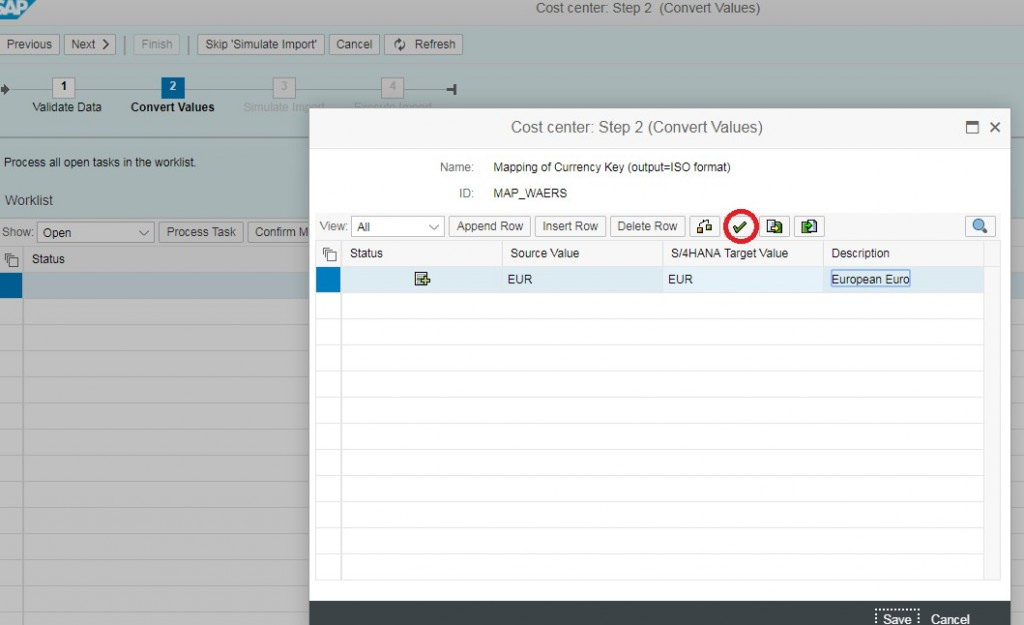
Once the data is uploaded into the tool, it is analyzed. The rest of the process differs from the historical LSMW tool. Indeed, in the old tool, the mapping between source data (Legacy) and target data (SAP) was manually configured by the user. While this allowed for a certain freedom, particularly through the ability to manage specific needs (e.g., format differences), this step was also a risk factor because it was often too complex, not very reusable, and relied on old technology. With the Migration Cockpit, the mapping between entered values and fields configured in SAP is performed automatically. However, the user retains oversight, as they must manually confirm that this mapping is correct (see image below). In short, one of the most complex steps of data transfer is now performed in a few clicks without risk of error.
The data transfer technology has been streamlined. Migration programs are now all of the same nature. The heterogeneous transfer methods of LSMW (Direct input, Recording, Idoc…) give way to a range of standard BAPI programs, each dedicated to a single migration object, and all executed in the background. The same transaction, SM37, can now be used to verify their proper execution. If necessary, these programs can be consulted via the single transaction LTMOM. Thus, advanced users can retrieve useful information from a handful of synthetic screens, regardless of the project.
3 – The Modularity of the Migration Cockpit
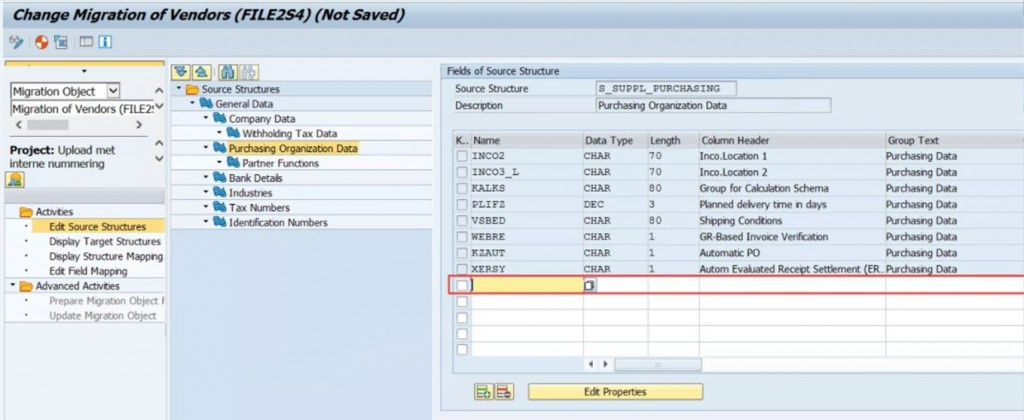
The list of objects managed by the Migration Cockpit already constitutes a fairly comprehensive catalog, especially since version 1809. However, if it does not cover all needs, users of S/4HANA On-premise or S/4HANA Cloud (exclusively on a private cloud) have broader possibilities thanks to the Migration Object Modeler. This functionality, accessible via transaction LTMOM, can be used to manage objects not present in the list. It also allows for the customization of existing standard programs. However, in this case, only the addition of new fields is permitted; the deletion or modification of existing standard templates is not possible (see image below).
Simplified, revamped, and standardized, while remaining customizable, this Migration Cockpit is therefore a major asset of the S/4HANA suite.
Do you need assistance to achieve a successful data migration?
Are you looking for expertise in SAP S/4HANA? With its experience in Data Migration, both in a Core-Model deployment context and S/4HANA implementation on a Greenfield, MeltOne Advisory can help you successfully complete your projects. Contact us at jsaccona@meltone.com. We will be happy to respond to you as soon as possible.
Let’s discuss your challenges and our solutions
Let’s talk about your project and discover how MeltOne can turn your challenges into concrete, high-performing solutions.