Microsoft Fabric: Unity is strength!
Nowadays, good data management has a significant impact on decision-making and business performance. However, leveraging this data involves a long journey, from ingestion to analysis, requiring numerous and complex operations with different tools. In May 2023, Microsoft announced the launch of Microsoft Fabric, which aims to centralize all the tools required for data processing into a single unified experience.
An all-in-one analytics platform
Microsoft Fabric is therefore positioned as an end-to-end analytics solution. It combines integration, engineering, data warehousing, data science, business intelligence, and more in a single solution.
It brings together the following services, most of which have been proven in Azure and reshaped in this new model.
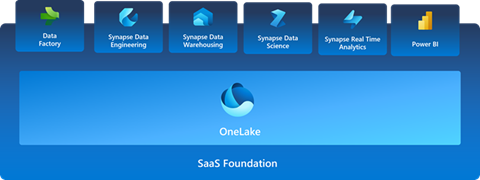
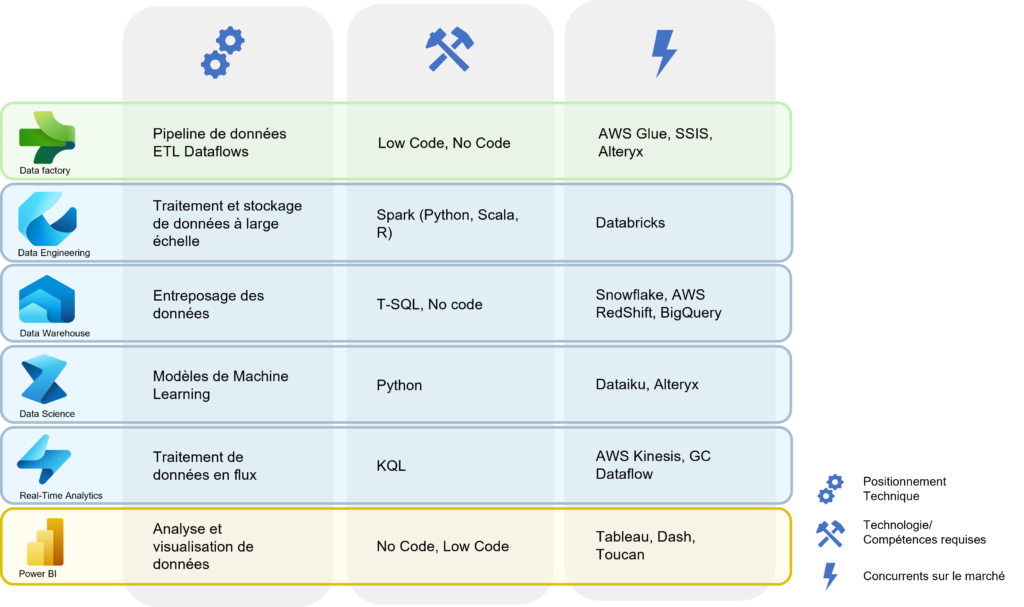
These one-by-one solutions are at least on par with their competitors. But Fabric stands out thanks to the interoperability of its services, all connected to OneLake.
OneLake—what is it?
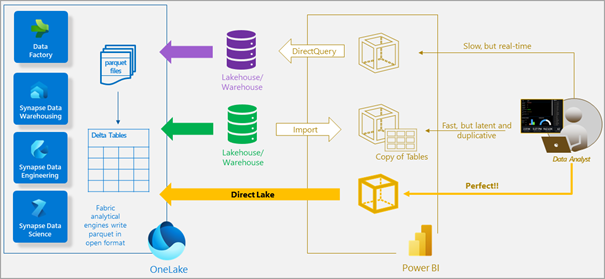
OneLake is a single Data Lake for the entire company, providing a single copy of data for the various services that use it. This means there is no longer any need to move or duplicate data from one system to another.
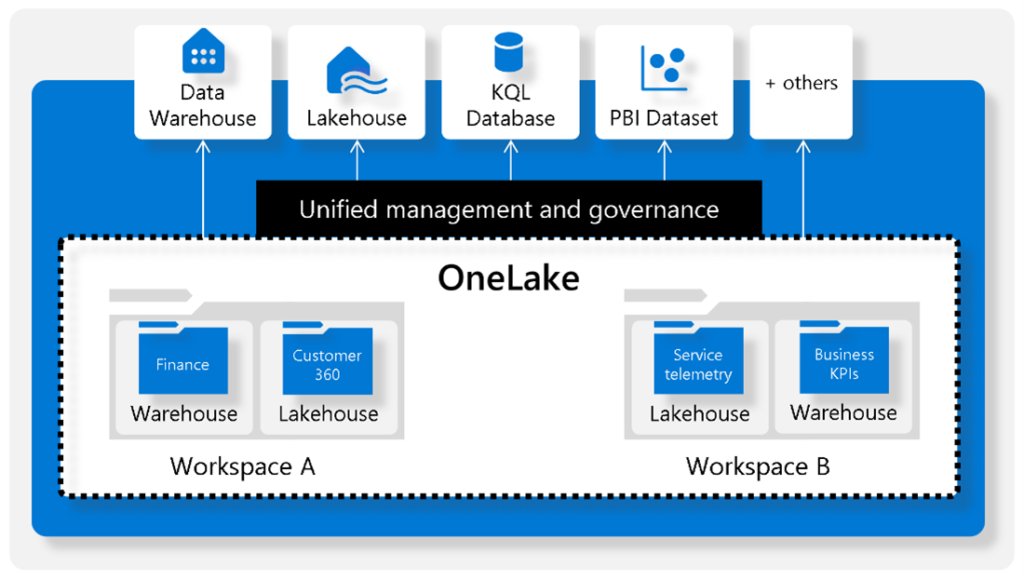
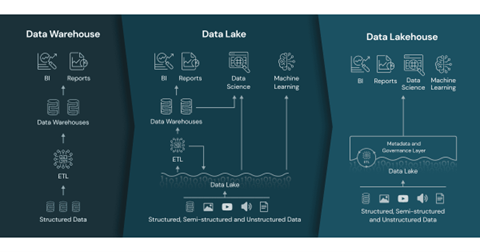
Data Lake, Data Warehouse, Lakehouse… it can be hard to keep track.
Simply put, a Data Lake enables large-scale storage of data in any format, while a Data Warehouse stores structured or semi-structured data—in other words, data that has already been processed and follows a certain governance.
A Lakehouse is nothing more than a combination of the two. The Lakehouse offers the flexibility and scalability of Data Lakes with the data structures and data management of a Data Warehouse.
Data is stored, processed, and analyzed from and to OneLake, exclusively via Parquet files—the file format for which large-scale data reads are the fastest. It is therefore easy to imagine the flexibility and performance with which data can be handled.
To identify an example of the impact of using OneLake, you just need to look at the end of the chain.
What’s new in Power BI
Using OneLake gives rise to a new connection mode in Power BI: Direct Lake. This new mode is added to the two existing modes, DirectQuery and Import, combining speed with support for frequent data updates. In this way, Direct Lake can process billions of rows almost instantly.
In addition, there is a major new feature for collaboration on Power BI reports. Indeed, a new save format is emerging: Power BI Project (.pbip). This makes it possible to save not a single file but a folder containing multiple files related to the report, separating Report and Dataset.
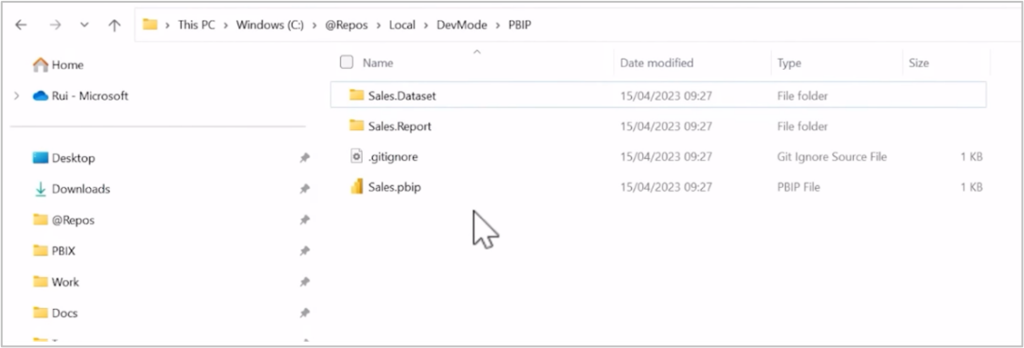
Such a folder makes it possible to create a Git repository, i.e., the ability for multiple people to work on the same report. This is a highly anticipated feature that will encourage teamwork in Power BI report development as well as versioning.
Added value for businesses
Microsoft Fabric is revolutionizing enterprise data management. It offers optimal performance, advanced scalability, and remarkable ease of use. This unified platform enables organizations to get the most out of their data, make informed decisions, and create value.
In addition, it enables all employees to work on a single online platform, making exchanges between teams smoother.
In short, Fabric’s watchword is unification. Fabric is therefore positioned as a major asset for companies looking to optimize their data management strategy in an evolving and complex environment.
If you would like to learn more, please contact us at: jsaccona@meltone.com
Let’s discuss your challenges and our solutions
Let’s talk about your project and discover how MeltOne can turn your challenges into concrete, high-performing solutions.