Digital Technology in Finance Departments #1 Functional Mapping vs. Software Vendors
Hugo Roch & Laura Izoard speak to us today about digital technology in Finance departments.
Following our previous article on the presentation of Digital within Finance Departments, we have decided to go further in our reflections and present the various functional improvements that digital solutions can bring through an ecosystem of software vendors. Our ambition for this article is to provide you with a simplified framework for understanding this topic.
The digitalization and automation of processes can be perceived as a legitimate solution to free up time for analysis and thus enable a consulting role within the company. This is where new digital technologies come in, offering real performance gains both on a transactional level (account matching, etc.) and on a decisional level (real-time vision and predictive simulation, for example). These solutions remain merely technological supports, and reflection on the process remains fundamental. However, if they are approached correctly, they are a formidable “armed wing” for these departments.
Business Use Case
In this article, we present some examples of processes that may be affected by this digitalization.
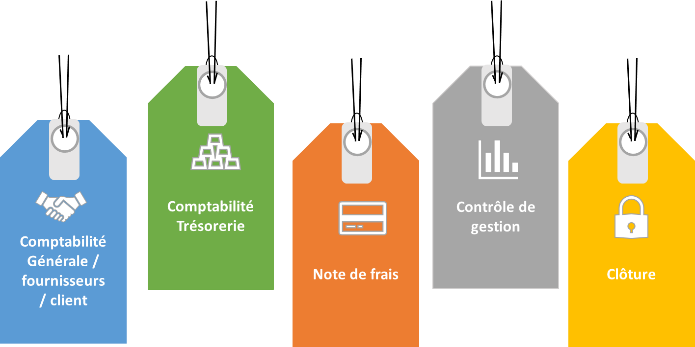
Finance Department
These processes have the particularity of facing a multitude of redundant tasks and, of course, are part of the pillars of a finance department.
We present below a selection of possibilities that can be implemented within your finance function. This illustration is not an exhaustive list of business “use cases”; its purpose is to provide a few concrete examples:
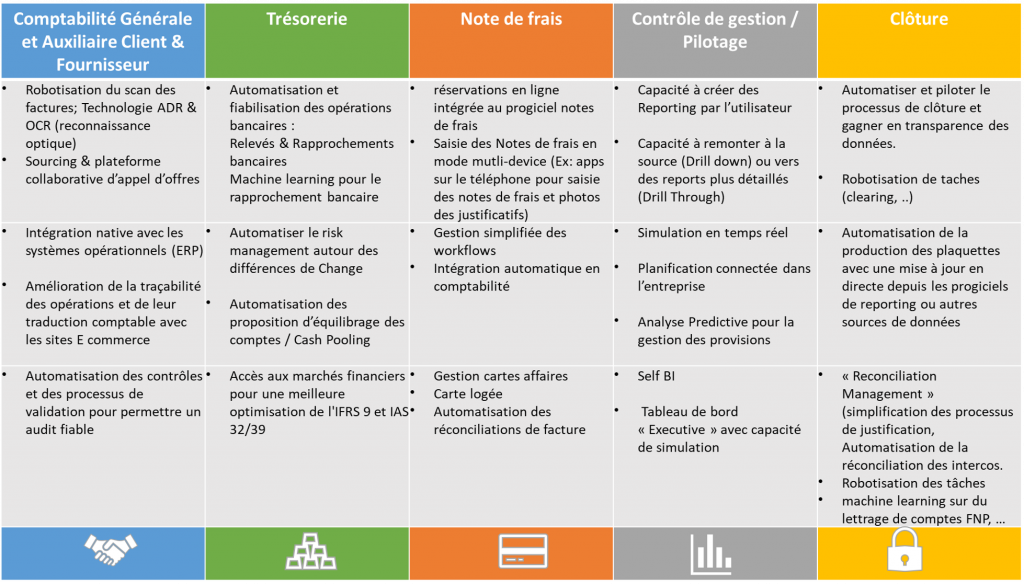
Chart: Area for improvement.
Vendor Mapping
“Legacy or new player”, “Cloud or no Cloud?” ….
Faced with this range of functionalities, a market has developed in which renowned software vendors are already present and offer various solutions. But as we mentioned in our previous article, strong competition is also appearing.
Indeed, the current trend favors finance solutions from the “digital” era: planning with collaborative workflow, invoice dematerialization, mobile executive dashboards, real-time data simulation…
Legacy vendors clearly suffer from complexity and a lack of agility – necessary today – amplified by the fact that their core technological base was not (re)designed to take full advantage of all the innovations brought by digital: cloud, big data, social media, collaborative accelerators… New vendors, smaller but more agile, are emerging: a new map is being drawn. This map offers new technologies that also meet the new needs of finance departments.
Intuitive, agile, connected, and above all simple to use, these new applications improve data management and reading, thus prioritizing more time for analysis rather than data collection.
We invite you to discover some of these digital players (legacy or recent). A summary description of them is provided further down in this article.
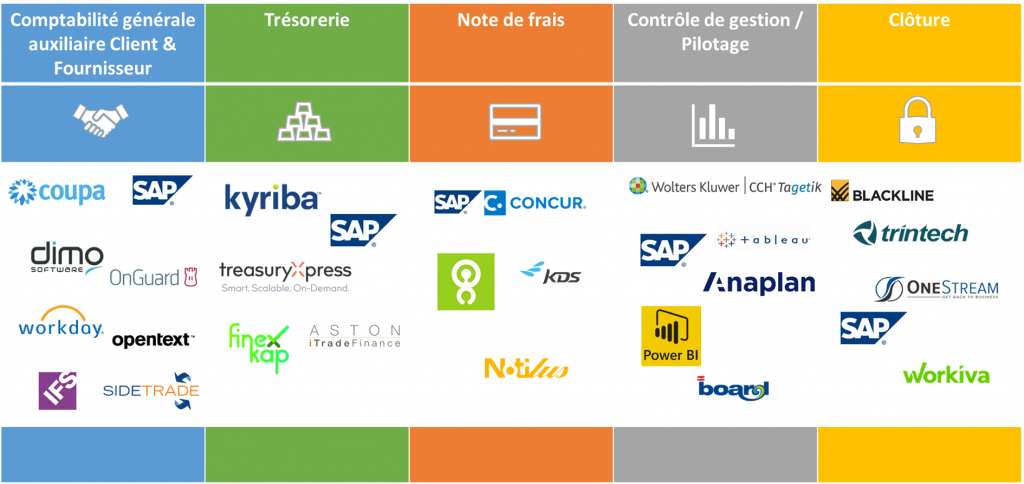
Key takeaways:
We are witnessing a digital revolution for finance departments in which new tools/vendors have appeared. This article provides you with an up-to-date selection.
Many are cloud “pure players”. This changes the investment approach but also the relationships between departments and existing methods (Business / Project Management / Technical Management). Please note that going to the Cloud does not mean that a CIO is no longer needed on a project. Their role remains relevant, particularly regarding the issues brought by these technologies (Security, Reversibility, etc.).
Regarding methodology, our conviction at MeltOne is that one must be extremely cautious about the forced implementation of an agile method on this type of project. Business processes in a Finance department are not redesigned like a website (fundamental questions must be addressed upstream during a Finance Common Core phase: scalability of the data model, interfacing principles, management of historical data recovery, etc. before being able to launch in Sprint mode). A mix of the V-model and agile method can help secure your projects or refocus poorly engaged trajectories. We would be very happy to present this type of approach to you.
In conclusion, it is certain that these new technologies represent a vehicle for change to be seized by finance departments if they wish to refocus on this idea of an “internal consulting role” (Vision, simulation, Analysis) for their Executive Committee.
MeltOne proposes to present in a series of upcoming reports and to illustrate all facets of digital for finance departments:
- Development of challenges and Current Status in Finance Departments: What if we interviewed the players? (Coming soon)
- Functional mapping vs. software vendors (Current Article)
- Example of a digital finance process (Coming soon)
Discover our digital offering: DIGITAL AT MELTONE
Would you like to learn more or assess your degree of maturity? Do you want to build a Digital roadmap or be supported in its implementation? MeltOne can help you, do not hesitate to contact us by email:
cmaurice@meltone.com (Digital Offering & Analytics Manager)
lizoard@meltone.com (Finance Consultant)
Let’s discuss your challenges and our solutions
Let’s talk about your project and discover how MeltOne can turn your challenges into concrete, high-performing solutions.