AI Agent in EPM: 6 Concrete Use Cases for Your Teams
AI Agent in EPM: 6 Concrete Use Cases for Your Teams
Finance AI agents have been in your EPM tools for a few months now. And yet, the question keeps coming back: “But concretely, what can we do with an AI agent?”
Good news: we have the answer. Here are 6 real use cases that will change your daily routine.
A Finance AI agent is an autonomous program embedded in your EPM tool. It performs analysis, control, or summarization tasks based on natural-language instructions. No code. No technical training. Just business common sense turned into a prompt. From one integrator to another, it’s more or less embedded, more or less flexible, but the principles and use cases always remain the same.
AI Agent 1: Data quality: the security guard for your numbers
The data quality agent automatically detects errors in Finance data across all connected sources and is enriched with business rules in natural language.
In Finance, we juggle an average of 8 to 9 data sources. That many entry points for errors. The data quality agent automatically detects, for example:
The real advantage? You enrich its control rules in natural language. No code. Just business common sense transformed into a prompt.
💡 Key takeaway: The quality of the analysis depends entirely on the quality of the data. This agent is therefore the foundation of everything else.
AI Agent 2: Finance Analyst: your colleague who never sleeps
The Finance analyst agent automatically produces Revenue, CAPEX, or EBITDA analyses according to defined parameters: alert thresholds, top 10, text or table format.
Imagine arriving in the morning with a first draft of analysis already ready, focused on key attention points.
That’s what this agent does. It knows your EPM model, your data, your formats. We delegate to it:
Revenue, CAPEX, EBITDA analysis…
Variance detection according to your thresholds
Identification of remediation scenarios
Output in text, table, or chart format.
All teams align first thing in the morning on a common synthesis. Depending on the technology, it’s more or less packaged and integrated, but always driven and guided via natural language prompts. Simple to learn, simple to evolve.
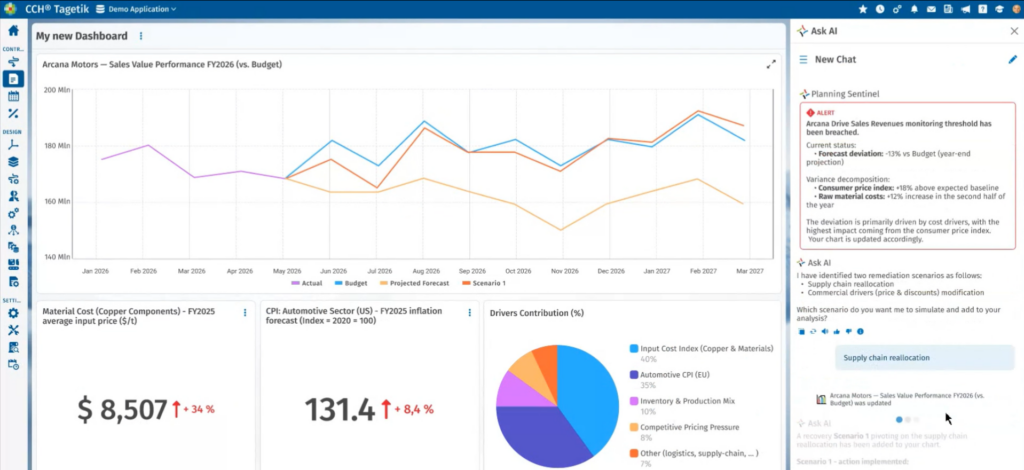
Here’s an example of the “Sentinel Cockpit” from CCH® Tagetik which identified a revenue drift and, based on a driver analysis, proposes correction scenarios.
💡 Key takeaway: certain predefined reports could well become obsolete.
AI Agent 3: Summary generation: goodbye blank-page syndrome
The summary generation agent automatically produces financial narratives from analyzed data, usable as-is or as a working draft.
Behind a good financial summary lie hours of analysis, root cause investigation, and writing. This agent takes care of it.
3 levels of use:
Subsidiary → generates a draft on its own numbers, refines it, focuses on sensitive points
Corporate → cross-references numbers and comments submitted to detect inconsistencies and context (“This BU is declining due to a supplier issue”)
Large scale → the same prompt automatically applied across all your BUs, functions, activities
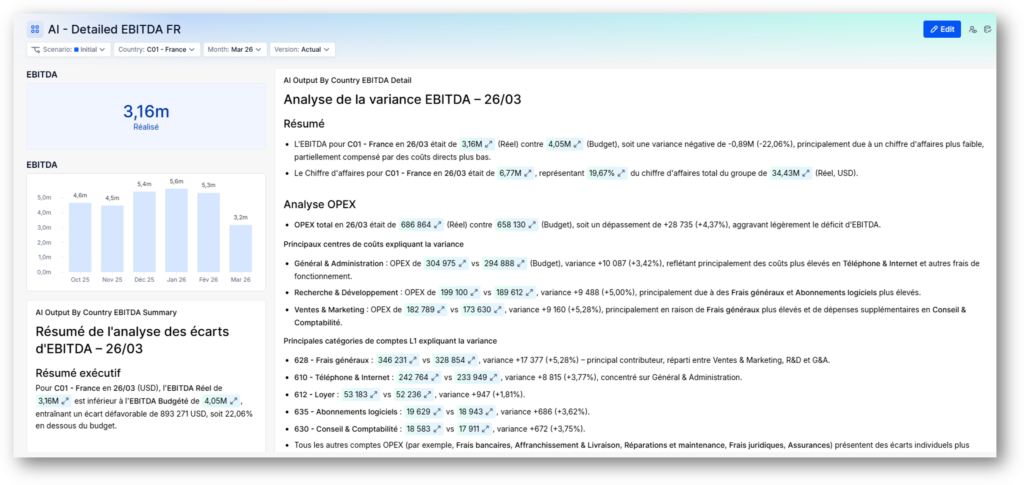
Here’s an example of a Pigment report showing summaries generated automatically by their “Analyst agent,” following an analysis method written in natural language by the business team. Note the option to select the country, as this report has been generated by the AI for each one.
If your analyses are recurring and always done the same way, the gains are significant. In just a few minutes, the agent produces its analysis your way. Your role is simply to validate, check, and take ownership of the key points highlighted. Several hours can be reduced to 30 minutes.
💡 Key takeaway: the summary can be used as-is or as a writing accelerator.
⚠️ Pause. What You Need to Know Before Going Further
We could have gone through all 6 agents without stopping. But there’s a part of the dream that needs demystifying first.
1. Delegating ≠ Abandoning Control
A Finance AI agent is like a very fast junior colleague: you delegate tasks to it, but you remain the owner of the result.
Generative AI sometimes makes mistakes. If an erroneous summary goes out in your department’s name, you’re the one responsible.
The real risk? Automatically generating a dozen summaries without reviewing them. Result: no time saved, just noise.
Plan for control time. It’s not optional.
💡 Key takeaway: the value of agents comes from the human + AI alliance. Not from replacing one with the other.
2. An Agent Doesn’t Fix a Broken Process
If your data is fragmented across multiple solutions without common governance, agents will only optimize each brick individually.
The real value (and the real pain) is often in end-to-end process optimization. An agent doesn’t replace thinking about data governance.
💡 Key takeaway: before deploying an agent, ask yourself about the consistency of your source data.
3. Native Agents Are More Reliable Than “Homemade” Agents
An agent embedded in your EPM solution has a key advantage: the vendor controls the data structure, technology, and guardrails.
Building an agent “outside the vendor” is possible, and sometimes relevant for creating links between applications, but it’s more costly and riskier due to the “generative” nature of this type of AI. However, in Finance, trust in numbers is a necessity. Reserve this for teams that have the technical-functional maturity to assume this choice.
💡 Key takeaway: start with the native agents of your platform. Custom solutions will come later.
That’s said. Let’s continue with the 3 most operational agents.
AI Agent 4: Scenario variance: the weak-signal hunter
The scenario variance agent identifies variances between budget, forecast, and prior year, at all levels of granularity, taking into account business constraints defined in the prompt.
Budget vs. Forecast vs. Prior Year: variance analysis at the aggregate level is easy. But in granular view, by business dimension, with weak signals? That’s another story.
This agent analyzes the entire scope, all phases combined, and takes into account your real constraints:
“This product is in known decline, we know it, we’re handling it, don’t flag it anymore.”
From one cycle to another, the prompt adapts to business reality. Same prompt, two different BUs → two different analyses, because variances are never in the same places.
Example of variance analysis prompt:
What’s truly powerful is the description of your analysis method. It’s not a predefined analysis method by AI, but rather you indicating how you conduct it within your department. We see here the macro approach (just the top 3 variances, then zoom on account/cost center combinations and display only those with ± 5000 variations)
Analysis

* Start by analyzing the REP OPEX metric,

compare Version Actuals vs  Budget at global level for the Current month.*

Identify the top 3 Cost Centers contributing to the total variance.

* Breakdown by Account L1 x Cost Center and flag only combinations  where the absolute variance between Version Actuals – Budget exceeds ±5000

For each flagged combination:

- Drill down further by Country

- Show variance in both Absolute terms (€) and Percentage (%) Formatting

* Start by a synthesis.

* Use bullet points to list key Account L1 and their associated variances.

* Add short explanations where possible.

* If there are more than 5 items, use a table instead.

* End by an action plan.
Output Format Example

- GL 60000 - Salaries: +€15.2k vs Budget (+18%) - Higher training expenses  in Marketing (+€8.7k)

- GL 62100 - Travel: –€11.3k vs Budget (–9%) - Fewer offsites held this quarter
This example is a prompt from the “Analyst agent” in Pigment.
💡 Key takeaway: no more unsuitable predefined reports. The analysis adapts to what you’re really looking for.
AI Agent 5: Version differences: the guardian of your validated data
The version-difference agent automatically compares two successive versions of a budget or close to identify changes, anomalies, and non-compliant data.
Between two budget versions or two closing submissions, time is limited. And yet, someone has to compare versions line by line. That someone is now the agent.
It scans comprehensively and produces granular lists for:
Subsidiaries → verify that no validated data has changed by mistake
Corporate → precisely identify what changed and why
💡 Key takeaway: you never know in advance where the change will occur. The agent looks everywhere.
AI Agent 6: Intercompany reconciliation: the diplomat of your entries
The intercompany reconciliation agent analyzes non-matching declarations, identifies probable causes, and proposes corrective entry scenarios to be validated by the user.
You keep control. The agent does the groundwork. For groups rich in intercompany transactions, the gains can be measured in days.
💡 Key takeaway: the agent proposes, the human decides. The best of both worlds.
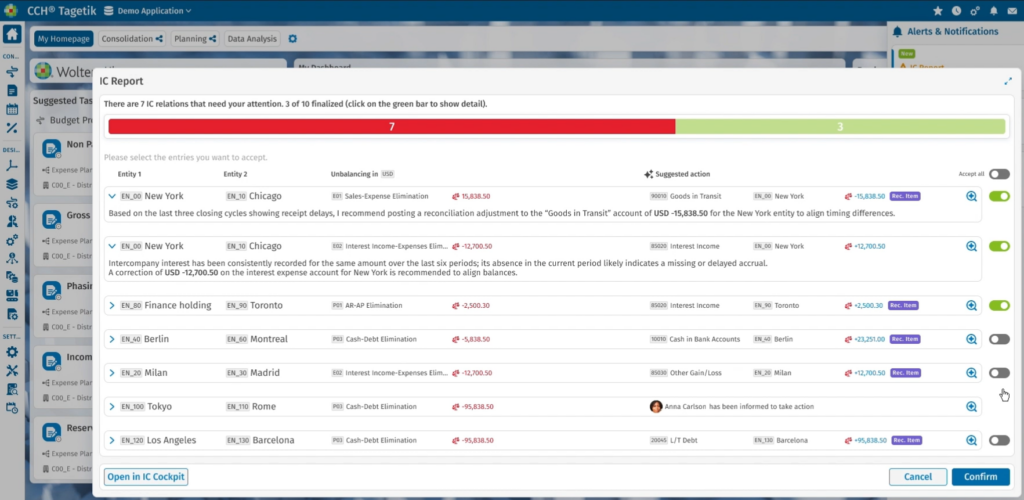
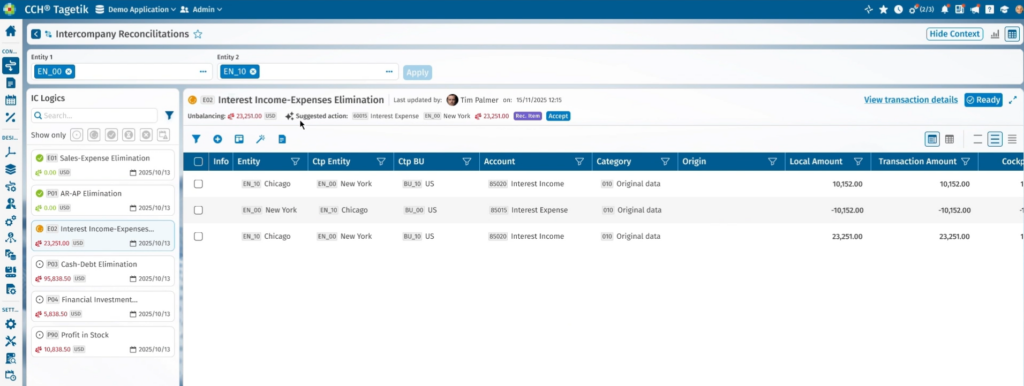
Above are 2 example screens with the “Touchless Reconciliation” from CCH® Tagetik. We see here the list of reconciliations that AI flags, the actions it recommends, and the reasons for this recommendation. You can then validate, investigate, or reject. The time savings are enormous.
This is only the beginning
Finance AI agents are not a gimmick. They’re already here, in your EPM systems, and the teams using them are getting ahead.
Honestly? This is one of the most exciting periods we’ve experienced in our EPM professions. Use cases are being invented in real time, with our clients, in the field. And the best ideas often come from those who know their processes best: you.
So get started on a non-critical process. It’s the only way to realize how easy to use and impactful it has become.
In summary:
Finance AI agents automate repetitive, low-value-added tasks
Data quality, analysis, summary, variances, versions, intercompany: each use case has its agent
Gains are measured in hours—sometimes days—on the most laborious processes
Humans must remain owners of the result: delegating does not mean abandoning control
FAQ
A Finance AI agent is an autonomous program integrated into your EPM tool. It executes analysis, control, or synthesis tasks on your financial data, based on natural language instructions.
No. They automate repetitive and low-value-added tasks. Teams will therefore focus on analysis, decision-making, and management.
No. Instructions are written in natural language, in the form of prompts. No technical skills are required.
Major platforms now integrate agentic capabilities: Pigment, CCH® Tagetik, Anaplan, Board… What differs is the release velocity of these agents, their level of integration, and their overall philosophy.
It depends on the maturity of your data and your EPM solution. A native agent on a well-structured platform can be operational in a few days.