A MeltOner’s Perspective on the 2018 USF Convention!
Lyon’s gastronomy, a UNESCO World Heritage. Since the 19th century, when you visit Lyon, you come to eat! The city clearly has nothing to be ashamed of compared to its competitors, given the specialties it offers. From grattons to tablier de sapeur, quenelles and cardons, the city fully deserves its status as the world capital of gastronomy.
But enough about food—what interests us today is of an entirely different nature, as the city of a thousand and one flavors hosted the USF trade show on October 10 and 11, the French-Speaking SAP Users Association. In its 2018 edition, the show pulled out all the stops. We tell you everything.
Designed for an informed audience, USF is an association comprising a full spectrum of SAP users aimed at sharing knowledge and experiences, discussing new solutions, and guiding and advising its members on tool selection.
USF now has more than 3,000 members, three-quarters of whom come from CAC40 companies, demonstrating the importance of the association’s network. Looking at the numbers, the 2018 convention exceeded 1,550 unique participants over the two days of the show, with a record number of 86 exhibitors (including MeltOne!).
During these two days, members and exhibitors were able to meet freely to share their experience, expertise, and expectations regarding SAP, as well as solutions and software peripheral to SAP (dealing with data security and processing, EPM, predictive analytics, etc.) in the coming years.
It was in this context that MeltOne decided to participate in USF in order to analyze more precisely the expectations and main objectives of the show’s SAP users.
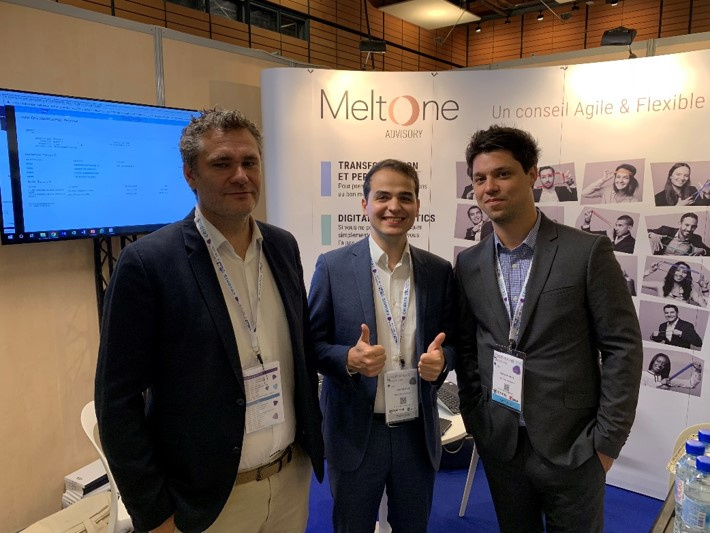
| The ERP team in great shape!
Data at the Heart of New Uses
“Data is a link that unites all technologies. Today, it is no longer just at the heart of technologies; it is at the heart of new uses. ,” reads the USF website.
As with every edition, the USF show highlights a theme on a current topic more or less directly related to innovation and digital technology. This year’s theme focused on data, its transformation in use, and its exploitation.
The program included 6 conferences dedicated to data analysis and more than 70 experience-sharing workshops to understand the challenges and define and discuss key success factors when implementing SAP solutions.
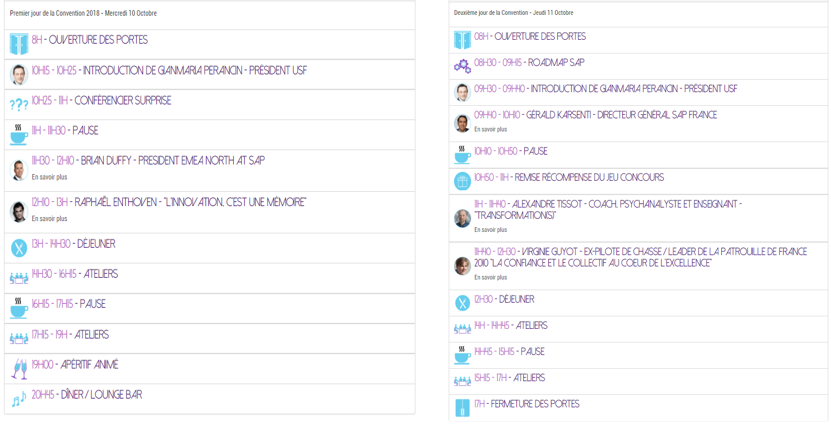
The show began with a presentation by Claude Molly-Mitton, none other than the former president of USF. The tone was set with a conference on e-reputation. This is a major challenge for companies because in a world of “fashion” and “consumption,” reputation data makes and breaks companies. Understanding and knowing the impact of data to be analyzed is therefore an essential challenge for companies regardless of their sector of activity.
This was followed by a presentation by Brian Duffy, SAP North EMEA President, on the importance of data in all types of industries, as well as a presentation by philosopher Raphaël Enthoven on the theme of innovation, “innovation is a memory,” to remind us that ultimately innovation is only a “means” and not an “end in itself.”
| An agenda featuring experience sharing and conferences!
The Data Era
As a consulting and IT solution integration firm, MeltOne takes part in solving these challenges with its clients. Today we talk about Big Data, IoT (Internet of Things), predictive analytics, and Industry 4.0. Ultimately, all these terms, which have entered common language, deal with the digital revolution whose smallest common denominator is none other than data!
What we observe in particular is that faced with the explosion in the volume of information and, by extension, data to be analyzed, the field of possibilities has taken on a whole new dimension: technologies have evolved, new uses have emerged. The challenge for CIOs is to meet the needs of other business functions—marketing, finance, management control, HR—which are heavy consumers of data, with high-performance analysis tools enabling mass processing, the whole challenge of Big Data. What changes compared to the more traditional approach, however, is that access to data is no longer exclusively available to technical experts, and power is returned to end users.
Today, data is used in all sectors of activity. The healthcare sector, for example, is very keen on using IoT technology in the workplace: “60% of healthcare facilities worldwide have integrated this technology into their operations, and 87% in total plan to do so by 2019” (source: study conducted by Aruba, a Hewlett Packard Enterprise company). 80% of facilities that have already adopted IoT note increased innovation, including access to patient data and the ability to make real-time diagnoses and perform prevention.
HR departments, in their recruitment process, are also consumers of data and are equipped with specialized information collection tools. Where do candidates come from? Did the resumes come through an employee, after an action conducted at a school? They are also used in terms of profile, regarding the training followed by the candidate. This also makes it possible to evaluate the duration of the recruitment process—is the time longer to invite candidates to an interview or, conversely, is it at the end of the process that it takes time? The examples are endless.
In a hyperconnected world where the mass of data is exponential, the most frequently recurring questions concern: data security, information dissemination and collaboration, information reporting, and the impact on the data model.
This may be the great paradox of our time. Data is present, it is everywhere, increasingly technical, exponential. The tools processing it must, for their part, be simple and didactic to use (example with Dataviz tools), all in order to return power to users over their data.
And What About the MeltOne Booth?
During these two days, our team of consultants answered a multitude of questions from USF members. Overall, what emerges from these exchanges is a desire by CIOs to project themselves in the medium term and migrate their entire application landscape to an S/4 HANA base. This desire is all the more true as the returns on investment on classic SAP ECC solutions have now been achieved and, as of 2024, SAP will probably no longer provide maintenance for its ECC6 business suite (at least for the time being).
Another important point, and as we have seen, data is more than ever a strategic challenge within companies, and time-based competition pushes companies to make the right decisions quickly in a fabric of data that continues to grow. This is the whole challenge of real-time processing and the main strength of the HANA database, which enables mass and instantaneous processing of large volumes of data.
Behind our booth, innovation was celebrated with demo access to an SAP S/4 cloud base in its 1809 version, the most recent, which allowed us to demonstrate our expertise on this solution of the future.
Members were able to use the tool and get an idea of the different dashboards and visual reports enabled by FIORI technology, which allows, among other things, customization of screens and access to the SAP base via mobile (PC, tablet, smartphone) through a secure URL.
MeltOne also answered more general questions about how to conduct an ERP project, as well as more technical questions about how to migrate to S4, Brownfield approach versus Greenfield approach, a major current concern for CIOs.
The first approach, called Brownfield, allows migration to S/4 Hana without disruption to the business and without having to rethink processes and replay migrations of master and transactional data. To this end, SAP offers a number of tools to operate this transition in the Hana logic. The strength of this approach will be its less costly investment in time and resources, since in this case it is a technical migration.
The Greenfield approach, on the other hand, favors a complete review of processes in a Best-Practice approach, ranging from the review and structure of master data (cleaning, rationalization, and improvement of data quality), transactional data (NewGL activation, review of accounting keys, new analytical dimensions) to the benchmarking and redesign of all organizational processes. The main advantage of this approach is process rationalization and therefore certain productivity gains, reduced TCO, and faster adoption of innovation. Its disadvantage lies in its cost in time and resources, since the Greenfield approach requires the participation of all stakeholders in a company.
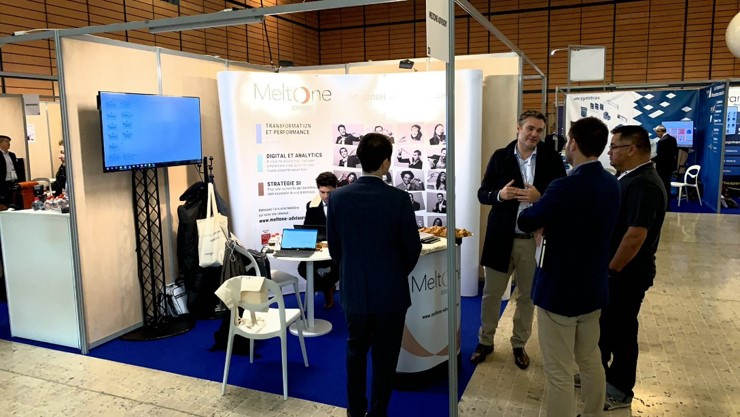
| 8:30 AM, no time to take off the coat, MeltOne welcomes its first visitors
These two days passed very quickly, and it is with a light heart and the idea of a job well done that we take the TGV back to Paris.
Thank you to USF and the city of Lyon for hosting us, and see you next year in Nantes for new digital adventures!
- Find all MeltOne offerings on our website: https://staging.meltone.com
- ERP: SAP S/4 HANA, Simple Finance/Logistics, SAP Cloud Platform
- EPM: SAP FC, SAP BPC, Anaplan, Tagetik
- Dataviz: SAP Analytics Cloud, Tableau, Power BI
- Predictive: SAP Predictive Analytics
- Project Management: Scoping Mission, Consulting and Project Management, AMOA Support Mission
Would you like to learn more and assess your level of maturity for a switch to S4? MeltOne can help you—do not hesitate to contact us: jsaccona@meltone.com
Let’s discuss your challenges and our solutions
Let’s talk about your project and discover how MeltOne can turn your challenges into concrete, high-performing solutions.