AI in Finance: 5 Tips for Getting Started in 2026
In this article, we share advice and feedback to help you understand where and how to start with artificial intelligence as a finance and data analytics professional.
In 2026, AI has become essential, as it increasingly permeates our daily lives.
However, this usage remains very superficial, particularly within many organizations. In a survey conducted in March 2026 by MeltOne among 50 finance decision-makers, although confidence in AI tools is high, or even very high for 75% of respondents, only 20% of them have defined a corporate strategy centered around its use. The conclusion is clear: many do not dare to dive into AI despite an obvious desire. When mentioned within the company, AI seems to remain stuck at the stage of presentation slides and committees.
Yet in 2026, it no longer requires courage to take the plunge into AI. You can navigate it without drowning. This is the goal of this article: to share advice and feedback to help you understand where and how to start with artificial intelligence as a finance and data analytics professional.
Prioritize utility over the impressive
How can you identify AI projects that truly transform the daily lives of finance teams?
Many organizations give in to the reflex of the flagship project: the one that can be discussed at conferences and makes for a beautiful slide. This is rarely the right starting point. The initiatives that endure are almost always those that simplify something concrete in the teams’ daily routines. A project that is brilliant on paper but ignored in practice leaves behind nothing but an expense report and collective frustration.
Start small, start useful; it is this discreet foundation that will provide legitimacy to everything that follows.
Efficiency is Born from Simplicity
Which simple AI applications can be deployed in finance today without complex infrastructure?
The most daring initiatives are often accompanied by great complexity and significant change management, which translates to increased challenges. Technologies such as artificial intelligence, autonomous agents, or innovative data infrastructures remain emerging fields, even for IT teams. It is preferable to initiate the process with concrete and accessible applications that are understandable to everyone, whether they are business specialists or IT professionals. Achieving an initial success and experimenting with new collaborative dynamics on a limited scope proves more productive than committing to an ambitious but uncertain undertaking.
Allow your organization to gradually assimilate these transformations.
AI is not magic
What preliminary steps are essential to avoid failures in a financial AI project?
Artificial intelligence cannot compensate for a poorly identified or imprecisely formulated problem. If procedures are vague or disorganized, it will not optimize them on its own. Before any implementation, it is essential to rigorously define the problem to be solved and the expected result. This step often allows for a re-examination of the basics and the structuring of processes that had previously remained informal. AI has its place, but its time will come after this indispensable clarification.
AI Will Only Be as Powerful as the Quality of Your Data (and Vice Versa)
How can you audit and prepare your financial data to maximize the performance of AI tools?
The results generated by artificial intelligence are inseparable from the quality of the data that feeds it. Incomplete, contradictory, or redundant information will lead to erroneous conclusions, as AI risks aggravating these biases rather than mitigating them. Before any implementation, it is crucial to verify that the data is reliable, consistent across systems, and correctly referenced. A preparatory phase of data cleaning and management is often necessary. Perfection is not required, but a minimum level of rigor remains essential.
Keep the human in the loop
Why and how should human expertise be integrated into AI processes in finance?
By design, generative AI models deliver outputs that may vary with each use, or even contain inaccuracies or gaps. In critical sectors like finance, where data accuracy is paramount, systematic human review is indispensable. AI must be perceived as a lever for efficiency and support, never as a replacement for professional judgment — especially during initial initiatives, where trust in these new practices is still being established.
What concrete steps can be taken right now?
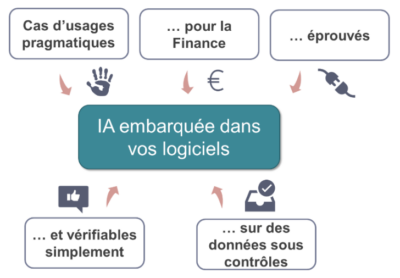
In light of these five recommendations, a question emerges: where can we identify concrete AI use cases specific to the financial sector that have been validated in real-world conditions? Applications that rely on controlled and verifiable data, and whose relevance is directly measured in our daily environment?
The answer is simple: prioritize native AI features within the tools already adopted by your teams. Vendors such as CCH Tagetik, Snowflake, Pigment, or SAP already offer these functionalities within their tools.
This strategy offers major advantages:
- Organized and controlled data, without the need for restructuring.
- Proven models, designed and certified by the vendors.
- Operational functionalities, ready for rapid deployment.
This approach constitutes the most secure, efficient, and accessible way to initiate a transition toward AI in finance.
MeltOne has designed its methodology to build a solid and sustainable AI roadmap!
Do you want to take your AI usage further in the coming weeks? MeltOne supports you by proposing an initial use case that makes sense for your challenges and constraints, all within a few weeks!