SAP Snowflake connector: simplify your data usage in 2026

The SAP Snowflake connector is now establishing itself as a structural response to the data challenges faced by finance departments. Too much time wasted on data preparation, too many discrepancies between systems, reports that are too slow: this technology partnership aims to change the game. In this article, we analyse what this connector concretely brings to Finance and Data teams, and under what conditions it creates value.

Why do finance and business departments still struggle to leverage their SAP data?


SAP is at the heart of the financial systems of many large organisations. Yet turning this data into actionable reporting remains a daily challenge.

  • Structural complexity specific to SAP environments

    SAP environments (FI/CO, SD, MM…) are highly standardised. Direct analytical use is complex. To extract value from them, teams must go through several steps:

    Extraction of raw data
    Transformation into dedicated analytical models
    Manual reconciliation between ERP, BI and reporting tools

    Result: according to AWS cloud, up to 80% of data teams’ time is spent on data preparation and cleansing, not analysis.

  • Financial cycles under pressure

    Finance and business departments face growing requirements:

    Faster monthly closes
    More frequent and more reliable forecasts
    Stronger auditability of figures

    In this context, relying on data engineering teams to produce each report becomes a major operational bottleneck.

Key takeaway: in a standard SAP environment, most data time goes into transforming data—not using it for business purposes.

What is the SAP Snowflake connector?


The SAP Snowflake connector is the result of a technology partnership between SAP and Snowflake. Its objective: eliminate complex replication flows and reduce friction between SAP data and its analytical use.

  • A more direct access approach to SAP data

    This is not about replacing SAP. It is about simplifying the path between SAP data and its analytical use. The model is based on three levers:
  • More direct access to SAP data in Snowflake (without heavy extraction)
  • Reduced data duplication between systems
  • Simplified transformation pipelines (fewer intermediate ETLs)

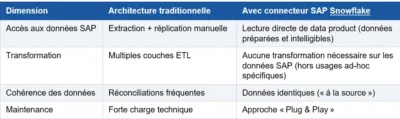
Comparison: traditional architecture vs SAP Snowflake connector

Dimension - Architecture traditionnelle - Avec connecteur SAP Snowflake Accès aux données SAP - Extraction + réplication manuelle - Lecture directe de data product (données préparées et intelligibles) Transformation - Multiples couches ETL - Aucune transformation nécessaire sur les données SAP (hors usages ad-hoc spécifiques) Cohérence des données - Réconciliations fréquentes - Données identiques (« à la source ») Maintenance - Forte charge technique - Approche « Plug & Play »

Product margin reporting


Let’s take a concrete example to illustrate the value of the SAP Snowflake connector in a Finance context.

  • Traditional situation, without the connector.

    Product margin reporting typically requires:

    An SAP extraction of accounting and sales
    Multiple rework steps in Excel or via ETL scripts
    Manual alignment of product master data between systems
    Consistency checks between ERP and BI

    This process is long, fragile and highly dependent on data engineering teams. The slightest change to the SAP chart of accounts can break the entire chain.
  • With an SAP Snowflake architecture

    SAP data is made accessible in Snowflake with its business context. Intermediate transformations are reduced. Master data is harmonised more smoothly.

Result: faster, more stable and better industrialised reporting—without relying on a shared Excel file on a drive.

Under what conditions does the SAP Snowflake connector create value?

There is no universal ROI. Gains depend heavily on each organisation’s context.

  • Several factors amplify the benefits

    Advanced data maturity in the organisation
    Complex SAP architecture with multiple instances
    High level of fragmentation between systems (ERP, consolidation, BI)
    Highly manual reporting processes today
  • What the SAP Snowflake connector guarantees

    Reduced data duplication
    Simplified transformation chains
    Reduced reconciliation effort
    Better governance of financial data
  • What it does not guarantee

    It would be inaccurate to put forward a universal quantified ROI or a cost reduction that can be directly extrapolated. Each project requires a specific assessment, grounded in the reality of the organisation.

Conclusion: the SAP Snowflake connector, a structural lever for Finance

The SAP Snowflake connector represents a structural evolution of financial data architectures, not a simple technical optimisation.

For finance departments, the value lies in three concrete capabilities:

  • Reduce the complexity of accessing SAP data

  • Make reporting and close processes more reliable

  • Reallocate time towards analysis and strategic steering

In summary: The SAP Snowflake connector enables finance and business departments to reduce the complexity of using SAP data by making it directly accessible in a cloud analytics environment. It removes intermediate transformation layers, makes financial reporting more reliable and accelerates close cycles.

MeltOne supports Data and Finance departments in implementing SAP Snowflake architectures tailored to their context.

Would you like to assess the potential for your organisation? Contact our experts.

Img Meltone 1

SAP Snowflake connector: frequently asked questions

No. The SAP Snowflake connector does not replace SAP. It simplifies access to SAP data from a cloud analytics environment (Snowflake). SAP remains the transactional management system.

A traditional ETL extracts, transforms and loads data in several distinct steps. The SAP Snowflake connector reduces these intermediate steps by enabling more direct, governed access to SAP data in Snowflake.

The SAP Snowflake connector creates more value in environments with complex SAP architectures. It is mainly relevant for organisations with multiple systems, large data volumes and structured data teams.

Deployment depends on the complexity of the existing SAP architecture and the organisation’s data maturity. Specialist support (such as that offered by MeltOne) helps accelerate implementation and secure the first Finance use cases.

The main prerequisites are: an active SAP instance, access to Snowflake, data governance in place, and a clear definition of the target use cases (reporting, forecasting, advanced Analytics).

What is our playing field?


The Finance architecture is built around three major building blocks: ERP (transactional system), EPM (performance management) and the Data Platform / Modern Data Stack. These blocks exchange data with each other. Historically, AI was externalised because it was too specific. Schematically, the Finance scope is based on three major building blocks:
  • ERP: the heart of the engine and all other operational and transactional systems: HRIS, CRM, Treasury, accounting ERP…
  • EPM: the management cockpit. It receives data from the ERP, aggregates it and produces a macro view: Management Reporting, Statutory Consolidation, Financial Planning & Analysis, planning
  • Data Platform / Modern Data Stack + BI: the technical building block that centralises and harmonises all your sources for detailed, cross-analyses.

These blocks exchange data with each other. Historically, AI and Data Science remained externalised: too technical, too specific.

That is no longer the case.

Image 5 1024x460

The impact of AI in Finance in ERP: a layered evolution

Important point: AI does not revolutionise ERP. It enriches it in successive layers, based on the historical core. This is consistent: what we look for in an ERP is process, rigour and governance. We do not disrupt that.

AI impact in Finance ERP diagram
The impact of AI in Finance on your architecture: AI is integrated in successive layers into each building block, without a revolution, with progressive enrichment. The layer of autonomous agents is the one that delivers real productive value, and it is evolving the fastest. MCP improves communication between applications without specific development. Data quality and governance remain the essential foundation. The data platform is emerging as a natural candidate for the role of control tower for the Finance architecture. The impact of AI in Finance in ERP: a layered evolution
AI in ERP does not revolutionise the historical operating model. It is enriched in successive layers: specific AI modules, conversational agents, autonomous agents, then MCP connection to the outside.
💡 Key takeaway:
AI in ERP does not revolutionise the historical operating model. It is enriched in successive layers: specific AI modules, conversational agents, autonomous agents, then MCP connection to the outside.

The impact of AI in Finance in ERP: a layered evolution

The impact of AI in Finance in EPM: faster, more flexible

AI in EPM follows the same layered logic as ERP, but with higher velocity. EPM is not the backbone of the company: changes are faster and more in the hands of the business.

The layered logic is identical to ERP. The difference: EPM is not the backbone of the company. It is the management cockpit; more flexible and more in the hands of the business. Changes therefore arrive faster.

AI impact in Finance EPM diagram

💡 To go further on these EPM use cases: AI Finance Agents: 6 concrete use cases by Stéphane Portier, Innovation Lead at MeltOne.

The impact of AI in Finance on your architecture: AI is integrated in successive layers into each building block, without a revolution, with progressive enrichment. The layer of autonomous agents is the one that delivers real productive value, and it is evolving the fastest. MCP improves communication between applications without specific development. Data quality and governance remain the essential foundation. The data platform is emerging as a natural candidate for the role of control tower for the Finance architecture. The impact of AI in Finance in ERP: a layered evolution
AI in ERP does not revolutionise the historical operating model. It is enriched in successive layers: specific AI modules, conversational agents, autonomous agents, then MCP connection to the outside.
💡 Key takeaway :
EPM becomes a true management assistant, not just a reporting tool.
AI in EPM follows the same layered logic as ERP, but with higher velocity. EPM is not the backbone of the company: changes are faster and more in the hands of the business.

The impact of AI in Finance in the Data Platform: the building block that accelerates the most

This building block has historically been the most technical. And yet, it is the one evolving the fastest under the impetus of AI. The goal: reduce dependency on IT and give Finance teams real autonomy over their data.

The Modern Data Stack is enriched with 3 AI layers: management and discovery of business context, autonomous AI agents for Finance, and on-demand creation of complete business applications. It becomes a candidate for the role of Finance control tower. This building block has historically been the most technical. And yet, it is the one evolving the fastest under the impetus of AI. The goal: reduce dependency on IT and give Finance teams real autonomy over their data.
AI impact in Finance Modern Data Stack diagram

The impact of AI in Finance on your architecture: AI is integrated in successive layers into each building block, without a revolution, with progressive enrichment. The layer of autonomous agents is the one that delivers real productive value, and it is evolving the fastest. MCP improves communication between applications without specific development. Data quality and governance remain the essential foundation. The data platform is emerging as a natural candidate for the role of control tower for the Finance architecture. The impact of AI in Finance in ERP: a layered evolution
AI in ERP does not revolutionise the historical operating model. It is enriched in successive layers: specific AI modules, conversational agents, autonomous agents, then MCP connection to the outside.
💡 Key takeaway:
The Modern Data Stack is enriched with 3 AI layers: management and discovery of business context, autonomous AI agents for Finance, and on-demand creation of complete business applications. It becomes a candidate for the role of Finance control tower.

What new Finance architecture does AI bring us?

The impact of AI in Finance on the overall architecture is visible in three areas: improved communication between applications via MCP, the continued importance of data quality and governance, and the persistence of an inter-application No Man’s Land that the data platform can help address. Beyond the evolution of each building block, let’s look at what their combination really brings in terms of the impact of AI in Finance.

1. Communication between your applications improves

Application silos are the daily constraint for Finance departments: delays, costs, errors. Communication via MCP is not anecdotal: it changes day-to-day work.

A concrete example with a cross-functional agent for your department. In a single chat:

  • You ask for the largest variances versus the Forecast
  • The agent identifies that the answer is in the EPM, and points to the Cost Center that is off
  • You ask for the details of the largest corresponding invoices
  • The agent identifies that this detail is in the data platform and brings back the right information
  • You look for who approved these invoices
  • The agent retrieves it from the ERP
  • You engage with the right people to understand and act

A centralised, governed data warehouse could have delivered this result. But that is rarely the case across the entire Finance scope. MCP can only partially compensate.

2. Data quality and governance remain key

AI does not erase data problems; it amplifies them. If a customer master or revenue calculation differs from one application to another, the AI’s answer will be inconsistent.

Data quality, master data unification, synchronisation of business rules, governance: these fundamentals remain just as critical in the AI world as in the old one. Preparing this foundation still makes sense for you—and for the AI that will navigate your master data.

3. Inter-application remains a No Man’s Land

AI enriches each building block. But many Finance processes still live outside these blocks—whether in Excel files, legacy applications, or manual processes. And making these blocks communicate remains complex. We would like, after a variance is detected in the EPM versus a Forecast, for an agent to go and study the detail in the data platform or the ERP to report contextual information, or even the root cause of the anomaly. We would also like, when it is simple and controlled, for it to automatically trigger corrective actions. And we would like all of this to have been done before even showing us our dashboards. But here we run into inter-application. That is why it is both a No Man’s Land and a gold mine for truly revolutionising our processes tomorrow.

Different options are emerging to address this No Man’s Land:

  • Agentic platforms on the market: promise of simplicity and fast time-to-value, but this adds a new application
  • The enterprise conversational agent (Claude, ChatGPT, Mistral, Copilot, Gemini): some entrust it with this gateway role
  • The data platform: a natural candidate. It already stores your main data, has been enriched with all the necessary agentic modules, and can orchestrate flows between your applications. It is relevant to see it as the future Finance control tower.

Be careful, however, of a common drift: believing that the data platform can replace everything. Finance applications provide a structuring architecture, robustness and governance that we seek in our professions. It orchestrates, it complements, it corrects—but it does not replace.

The impact of AI in Finance on your architecture: AI is integrated in successive layers into each building block, without a revolution, with progressive enrichment. The layer of autonomous agents is the one that delivers real productive value, and it is evolving the fastest. MCP improves communication between applications without specific development. Data quality and governance remain the essential foundation. The data platform is emerging as a natural candidate for the role of control tower for the Finance architecture. The impact of AI in Finance in ERP: a layered evolution
AI in ERP does not revolutionise the historical operating model. It is enriched in successive layers: specific AI modules, conversational agents, autonomous agents, then MCP connection to the outside.


💡 Key takeaway :
The impact of AI in Finance on the overall architecture is visible in three areas: improved communication between applications via MCP, the continued importance of data quality and governance, and the persistence of an inter-application No Man’s Land that the data platform can help address.


In summary: the impact of AI in Finance on your architecture

  • AI is integrated in successive layers into each building block, without a revolution, with progressive enrichment
  • The layer of autonomous agents is the one that delivers real productive value, and it is evolving the fastest
  • MCP improves communication between applications without specific development
  • Data quality and governance remain the essential foundation
  • The data platform is emerging as a natural candidate for the role of control tower for the Finance architecture

FAQ

The impact of AI in Finance manifests in layers across each building block (ERP, EPM, data platform). It improves communication between applications via MCP servers and extends analysis and automation capabilities. It does not replace existing architectures: it augments them.

An MCP (Model Context Protocol) server enables an enterprise conversational agent (Claude, Mistral, Copilot…) to query a Finance application in natural language, without specific development. ERP, EPM and data platforms now expose their own MCP servers.

No. AI enriches these solutions in successive layers. It does not change their nature. An ERP remains the transactional system of record. An EPM remains the management cockpit. AI adds autonomy, proactivity and connections.

Start with the native agents in your existing solutions. Assess the quality and governance of your data. Identify a non-critical process to experiment with. Gains are measured quickly. The same applies to learning.

No. It can play a control-tower and orchestration role between applications. But ERP and EPM provide a structuring architecture, robustness and governance that the data platform does not replace.

Glossary

Automapping* : a technique that automatically matches accounts in different formats between two systems, without manual intervention. Used in particular for reconciliation and consolidation.

Interco (intercompany reconciliation)*: the process of reconciling transactions between entities within the same group to eliminate internal flows during consolidation.

Matching*: an accounting operation that consists of matching debit and credit entries to identify payments corresponding to invoices.

MCP (Model Context Protocol)* : a standard protocol that enables an enterprise conversational agent (Claude, Mistral, Copilot…) to query and interact with third-party applications in natural language, without specific development.

Modern Data Stack*: a modern set of cloud technologies dedicated to collecting, storing, transforming and visualising enterprise data.

OCR (Optical Character Recognition)*: optical character recognition technology that converts images or scanned documents into text that can be used digitally.

Let’s discuss your challenges and our solutions

Let’s talk about your project and discover how MeltOne can turn your challenges into concrete, high-performing solutions.

Img Meltone 9