Snowflake: Cloud Platform with a Unique Architecture
Snowflake aims to change this persistent paradigm and offers a solution that centralizes needs. Indeed, Snowflake serves as your Data Warehouse, your Data Lake, and your Data Marts. Thanks to this unique solution, it is now possible to rethink enterprise data management.
I – Snowflake, Data Platform as a Cloud Service
‘On-premise’ solutions refer to applications physically run from a local server. In this case, it is essential to install the solution on the company’s servers. This also implies setting up maintenance with an on-site team. Conversely, Snowflake has built a completely cloud-based solution, making it a pure cloud player. Snowflake thus handles tool maintenance and is accessible with a simple internet connection. In a context where resource demands are constantly growing and maintaining an on-site presence is complicated, Snowflake offers to eliminate the manual management, deployment, and configuration of software or hardware.
II – Snowflake, a New Way to Think About Enterprise Data Management
Generally, for many years, the way data architecture has been conceived has changed very little. Most data engineers still imagine a schema of this type today:
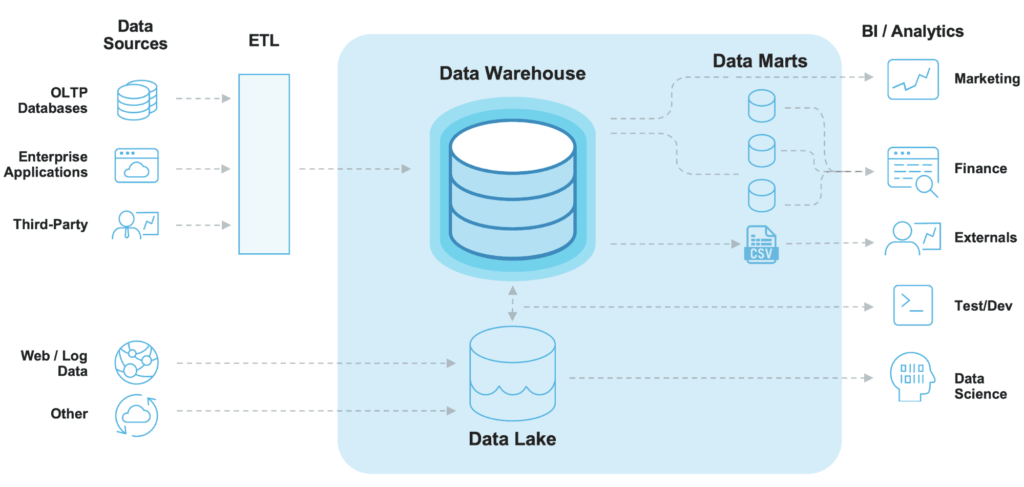
It includes three distinct elements: Data Warehouse, Data Lake, and Data Marts. The traditional Data Warehouse could not meet the specific needs and workload of end-users, which is why Data Marts emerged. Furthermore, Data Lakes came into being because they also could not store excessively large volumes of data.
Even today, Data Warehouses are unable to absorb all the workloads imposed on them in companies, even with a cloud Data Warehouse. These three heterogeneous layers result in siloed data management by companies, thus multiplying technologies and resources.
Snowflake aims to change this persistent paradigm and offers a solution that centralizes needs. Indeed, Snowflake serves as your Data Warehouse, your Data Lake, and your Data Marts. Thanks to this unique solution, it is now possible to rethink enterprise data management. Snowflake helps break down the barriers between previously siloed systems by creating a platform for all enterprise data:
Finally, unlike other cloud solutions, Snowflake is the only global and cross-cloud platform (Google Cloud, AWS, Azure). Indeed, this pure cloud player is the only one to offer a complete enterprise data management experience (governance, live data sharing without replication, inter-cloud, ACID-compliant transactions, etc.).
III. A Unique Architecture
As mentioned previously, Snowflake has rethought data management to create its own architecture. This centralization of needs materializes into an innovative architecture:
This solution is composed of three layers:
- Service or Cloud layer: Management, security, metadata, etc.
- Multi-cluster compute layer: Compute resources.
- Centralized Database Storage: Data storage.
Snowflake stores data in a single source of truth without any replication. It is then possible to share, combine, or query the data.
Compute power is managed using “virtual warehouses.” They are defined by a size and a number of clusters. Increasing the size of the ” virtual warehouse” improves its computing power and thus its performance. Conversely, a large number of clusters allows for executing a high number of queries by parallelizing tasks.
Snowflake’s shared data and multi-cluster architecture enables companies to manage large volumes of data, workloads, and numbers of users.
Unlike most other solutions on the market, Snowflake offers the ability to modify the size and number of clusters of ” virtual warehouses” in real-time. An unforeseen event requiring high capacities can be managed immediately. Furthermore, in addition to traditional billing, Snowflake offers to bill only for the resources actually used. Imagine a project where it’s possible to flexibly adapt compute resources while only being billed for actual usage. These aspects of the solution demonstrate its full scalability.
IV. Integrating Snowflake into an Established Ecosystem
Many data integration, business intelligence, data science, and even data security and governance tools provide native connectivity to Snowflake.
This plurality of connectors allows for simple integration of Snowflake into an existing data ecosystem.
It is now clear that Snowflake offers a centralized platform, enabling current businesses to access the performance, scalability, and elasticity they need.
Would you like to learn more about Snowflake and its features? Do you want to centralize your needs with a simple and effective tool? We are available to assist you in this process. Feel free to contact us at ybusidan@meltone.com or jsaccona@meltone.com.
Let’s discuss your challenges and our solutions
Let’s talk about your project and discover how MeltOne can turn your challenges into concrete, high-performing solutions.