SAP Snowflake connector: simplify your data usage in 2026

The SAP Snowflake connector is now establishing itself as a structural response to the data challenges faced by finance departments. Too much time wasted on data preparation, too many discrepancies between systems, reports that are too slow: this technology partnership aims to change the game. In this article, we analyse what this connector concretely brings to Finance and Data teams, and under what conditions it creates value.

Why do finance and business departments still struggle to leverage their SAP data?

SAP is at the heart of the financial systems of many large organisations. Yet turning this data into actionable reporting remains a daily challenge.


Structural complexity specific to SAP environments
SAP environments (FI/CO, SD, MM, etc.) are highly standardised. Direct analytical use is complex. To extract value from them, teams have to go through several steps: extraction of raw data, transformation into dedicated analytical models, manual reconciliation between ERP, BI and reporting tools. Result: according to AWS cloud, up to 80% of data teams’ time is spent preparing and cleaning data, not analysing it.

Financial cycles under pressure – finance and business departments are facing increasing demands:

  • Faster monthly closes
  • More frequent and more reliable forecasts
  • Stronger auditability of figures

In this context, relying on data engineering teams to produce each report becomes a major operational bottleneck.


What is the SAP Snowflake connector?

The SAP Snowflake connector is the result of a technology partnership between SAP and Snowflake. Its objective: eliminate complex replication flows and reduce friction between SAP data and its analytical use.

A more direct access approach to SAP data

This is not about replacing SAP. It is about simplifying the path between SAP data and its analytical use. The model is based on three levers:

  • More direct access to SAP data in Snowflake (without heavy extraction)
  • Reduced data duplication between systems
  • Simplified transformation pipelines (fewer intermediate ETLs)

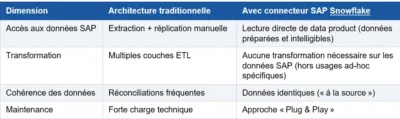
Comparison: traditional architecture vs SAP Snowflake connector

Dimension - Architecture traditionnelle - Avec connecteur SAP Snowflake Accès aux données SAP - Extraction + réplication manuelle - Lecture directe de data product (données préparées et intelligibles) Transformation - Multiples couches ETL - Aucune transformation nécessaire sur les données SAP (hors usages ad-hoc spécifiques) Cohérence des données - Réconciliations fréquentes - Données identiques (« à la source ») Maintenance - Forte charge technique - Approche « Plug & Play »

Product margin reporting

Let’s take a concrete example to illustrate the value of the SAP Snowflake connector in a Finance context.


Traditional situation, without the connector.

Product margin reporting typically requires:

An SAP extraction of accounting and sales
Multiple rework steps in Excel or via ETL scripts
Manual alignment of product master data between systems
Consistency checks between ERP and BI

This process is long, fragile and highly dependent on data engineering teams. The slightest change to the SAP chart of accounts can break the entire chain.


With an SAP Snowflake architecture

SAP data is made accessible in Snowflake with its business context. Intermediate transformations are reduced. Master data is harmonised more smoothly.


Result: faster, more stable and better industrialised reporting—without relying on a shared Excel file on a drive.

 

Under what conditions does the SAP Snowflake connector create value?

Several factors amplify the benefits

Advanced data maturity in the organisation
Complex SAP architecture with multiple instances
High level of fragmentation between systems (ERP, consolidation, BI)
Highly manual reporting processes today

What the SAP Snowflake connector guarantees

Reduced data duplication
Simplified transformation chains
Reduced reconciliation effort
Better governance of financial data

What it does not guarantee

It would be inaccurate to put forward a universal quantified ROI or a cost reduction that can be directly extrapolated. Each project requires a specific assessment, grounded in the reality of the organisation.

Conclusion: the SAP Snowflake connector, a structural lever for Finance

The SAP Snowflake connector represents a structural evolution of financial data architectures, not a simple technical optimisation.

For finance departments, the value lies in three concrete capabilities:

  • Reduce the complexity of accessing SAP data

  • Make reporting and close processes more reliable

  • Reallocate time towards analysis and strategic steering

In summary: The SAP Snowflake connector enables finance and business departments to reduce the complexity of using SAP data by making it directly accessible in a cloud analytics environment. It removes intermediate transformation layers, makes financial reporting more reliable and accelerates close cycles.

MeltOne supports Data and Finance departments in implementing SAP Snowflake architectures tailored to their context.

Would you like to assess the potential for your organisation? Contact our experts.

Img Meltone 1

SAP Snowflake connector: frequently asked questions

No. The SAP Snowflake connector does not replace SAP. It simplifies access to SAP data from a cloud analytics environment (Snowflake). SAP remains the transactional management system.

A traditional ETL extracts, transforms and loads data in several distinct steps. The SAP Snowflake connector reduces these intermediate steps by enabling more direct, governed access to SAP data in Snowflake.

The SAP Snowflake connector creates more value in environments with complex SAP architectures. It is mainly relevant for organisations with multiple systems, large data volumes and structured data teams.

Deployment depends on the complexity of the existing SAP architecture and the organisation’s data maturity. Specialist support (such as that offered by MeltOne) helps accelerate implementation and secure the first Finance use cases.

The main prerequisites are: an active SAP instance, access to Snowflake, data governance in place, and a clear definition of the target use cases (reporting, forecasting, advanced Analytics).