The Impact of AI in Finance: How Are Your Architectures Evolving?

The impact of AI in Finance on your architecture: AI is integrated through successive layers in each brick, without revolution, through progressive enrichment. The autonomous agents layer is the one that carries the true productive value and is enriching the fastest. MCP improves communication between applications without specific development. Data quality and governance […]

The impact of AI in Finance is not limited to a few new features in your software. It is a deep transformation, brick by brick, and then in their interactions.

Yet, the subject remains difficult to interpret. Vendors each communicate within their own scope. Without a global perspective, it feels like everyone is doing the same thing. This article offers exactly that perspective: less detail, more overall vision.

What is our playing field?


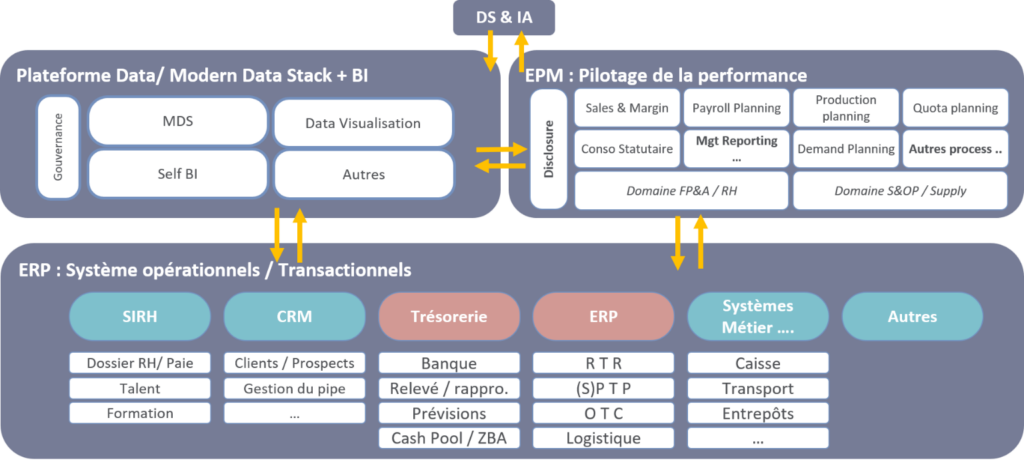
The Finance architecture is built around 3 main bricks: ERP (transactional system), EPM (performance management), and the Data Platform / Modern Data Stack. These bricks exchange data with each other. Historically, AI was outsourced because it was too specific. To simplify, the Finance scope rests on 3 main bricks:
  • ERP: the heart of the reactor and all other operational and transactional systems: HRIS, CRM, Treasury, accounting ERP…
  • EPM: the steering cockpit. It receives data from the ERP, aggregates it, and produces a macro vision: Management Reporting, Statutory Consolidation, Financial Planning & Analysis, planning
  • Data Platform / Modern Data Stack + BI: the technical brick that centralizes and harmonizes all your sources for detailed and cross-referenced analyses.

These bricks exchange data with each other. Historically, AI and Data Science remained outsourced: too technical, too specific.

This is no longer the case.

Image 5 1024x460

The Impact of AI in Finance in the ERP: An Evolution by Layers

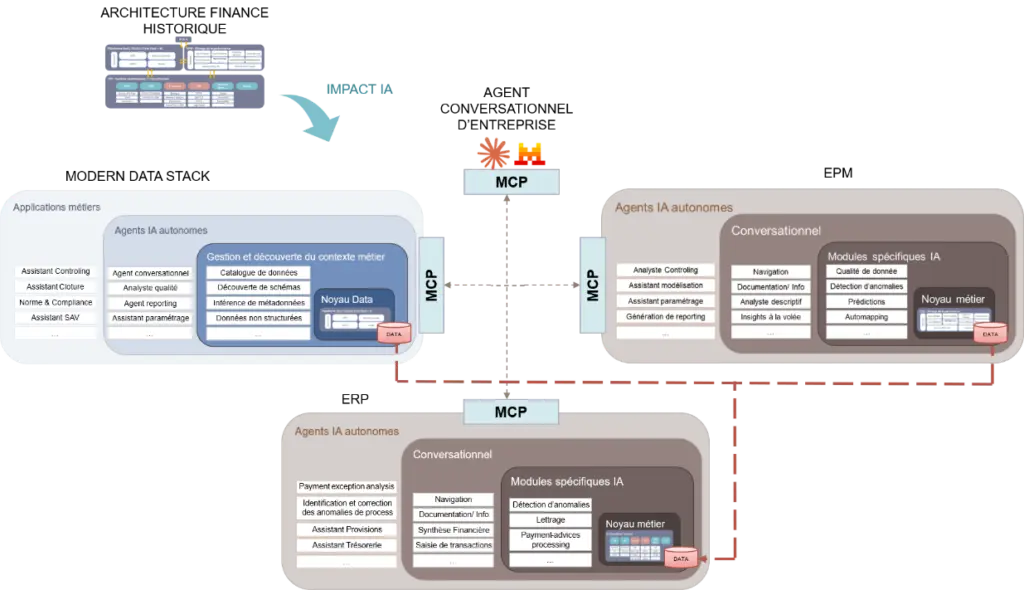
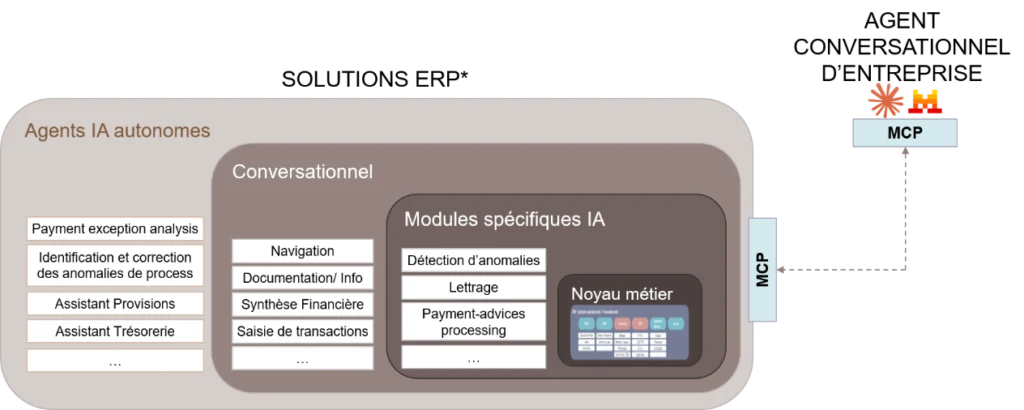
Important point: AI does not revolutionize the ERP. It enriches it through successive layers, based on the historical core. This is consistent: what we look for in an ERP is process, rigor, and governance. We don’t overturn that.

the impact of AI in Finance ERP Diagram
The impact of AI in Finance on your architecture: AI is integrated through successive layers in each brick, without revolution, through progressive enrichment. The autonomous agents layer is the one that carries the true productive value and is enriching the fastest. MCP improves communication between applications without specific development. Data quality and governance remain the essential foundation. The data platform emerges as a natural candidate for the role of control tower for the Finance architecture. The impact of AI in Finance in the ERP: an evolution by layers
AI in the ERP does not revolutionize historical operations. It enriches it through successive layers: specific AI modules, conversational agents, autonomous agents, then MCP connection to the outside.
💡 Key takeaway:
AI in the ERP does not revolutionize historical operations. It enriches it through successive layers: specific AI modules, conversational agents, autonomous agents, then MCP connection to the outside.

The Impact of AI in Finance in the ERP: An Evolution by Layers

The Impact of AI in Finance in the EPM: Faster, More Flexible

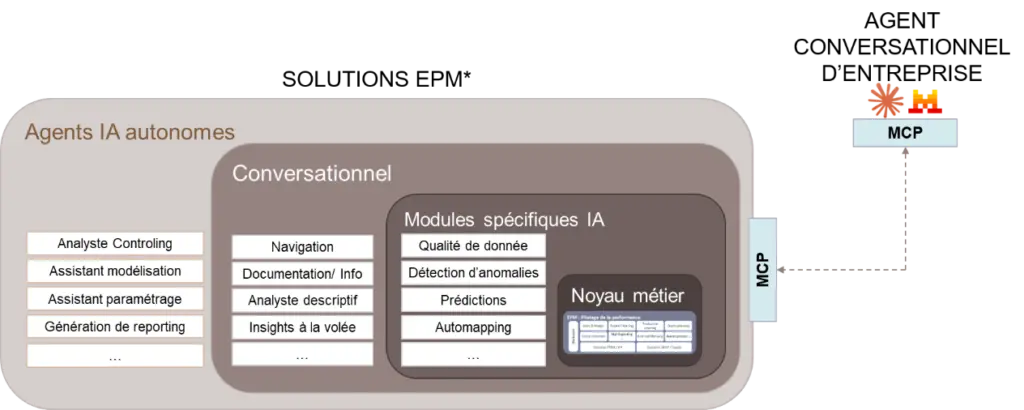
AI in the EPM follows the same layered logic as the ERP, but with higher velocity. The EPM is not the backbone of the company: developments there are faster and more in the hands of the business users.

The layered logic is identical to the ERP. The difference: the EPM is not the backbone of the company. It is the steering cockpit; more flexible and more in the hands of the business users. Developments therefore arrive there faster.

the impact of AI in Finance EPM Diagram

💡 To go further on these EPM use cases: Finance AI Agents: 6 Concrete Use Cases by Stéphane Portier, Head of Innovation at MeltOne.

The impact of AI in Finance on your architecture: AI is integrated through successive layers in each brick, without revolution, through progressive enrichment. The autonomous agents layer is the one that carries the true productive value and is enriching the fastest. MCP improves communication between applications without specific development. Data quality and governance remain the essential foundation. The data platform emerges as a natural candidate for the role of control tower for the Finance architecture. The impact of AI in Finance in the ERP: an evolution by layers
AI in the ERP does not revolutionize historical operations. It enriches it through successive layers: specific AI modules, conversational agents, autonomous agents, then MCP connection to the outside.
💡 Key takeaway:
The EPM becomes a true steering assistant, not just a reporting tool.
AI in the EPM follows the same layered logic as the ERP, but with higher velocity. The EPM is not the backbone of the company: developments there are faster and more in the hands of the business users.

The Impact of AI in Finance in the Data Platform: The Brick That Accelerates the Most

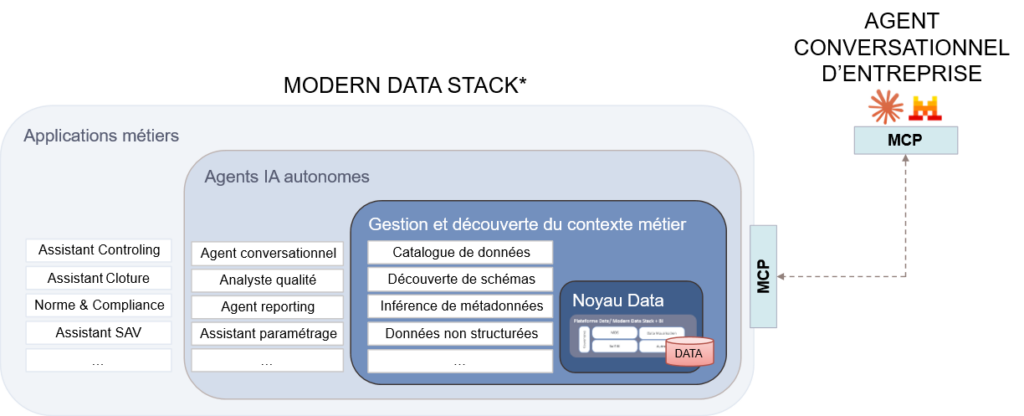
This brick is historically the most technical. And yet, it is the one evolving the fastest under the impulse of AI. The goal: reduce dependence on IT and give Finance teams true autonomy over their data.

The Modern Data Stack is enriched with 3 AI layers: management and discovery of business context, autonomous AI agents for Finance, and the creation of complete business applications on demand. It becomes a candidate for the role of Finance control tower. This brick is historically the most technical. And yet, it is the one evolving the fastest under the impulse of AI. The goal: reduce dependence on IT and give Finance teams true autonomy over their data.
the impact of AI in Finance Modern Data Stack Diagram

The impact of AI in Finance on your architecture: AI is integrated through successive layers in each brick, without revolution, through progressive enrichment. The autonomous agents layer is the one that carries the true productive value and is enriching the fastest. MCP improves communication between applications without specific development. Data quality and governance remain the essential foundation. The data platform emerges as a natural candidate for the role of control tower for the Finance architecture. The impact of AI in Finance in the ERP: an evolution by layers
AI in the ERP does not revolutionize historical operations. It enriches it through successive layers: specific AI modules, conversational agents, autonomous agents, then MCP connection to the outside.
💡 Key takeaway:
The Modern Data Stack is enriched with 3 AI layers: management and discovery of business context, autonomous AI agents for Finance, and the creation of complete business applications on demand. It becomes a candidate for the role of Finance control tower.

What New Finance Architecture Does AI Bring Us?

The impact of AI in Finance on the overall architecture manifests in 3 points: improved communication between applications via MCP, maintained importance of data quality and governance, and the persistence of an inter-application No Man’s Land that the data platform can help address. Beyond the evolution of each brick, let’s see what their combination actually brings in terms of AI impact in Finance.

1. Communication between your applications is improving

Application silos are the daily constraint of Finance departments: delays, costs, errors. Communication via MCP is not anecdotal: it changes daily life.

A concrete example with a cross-functional agent for your department. In a single chat:

  • You ask for the largest variances compared to the Forecast
  • The agent identifies that the answer is in the EPM, and points to the failing Cost Center
  • You ask for the details of the largest corresponding invoices
  • The agent identifies that this detail is in the data platform and retrieves the correct information
  • You look for who validated these invoices
  • The agent looks in the ERP
  • You exchange with the right people to understand and act

A centralized and governed Data Warehouse could have given this result. But this is rarely the case across the entire Finance scope. MCP can only partially compensate.

2. Data quality and governance remain key

AI does not erase data problems, it amplifies them. If a customer master file or revenue calculation differs from one application to another, the AI’s response will be inconsistent.

Data quality, master data unification, synchronization of business rules, governance: these fundamentals remain as critical in the AI world as in the old one. Preparing this foundation always makes sense for you, and for the AI that will navigate your repositories.

3. Inter-application remains a No Man’s Land

AI enriches each brick. But many Finance processes still live outside these bricks, whether in Excel files, legacy applications, or manual processes. And making these bricks communicate remains complex. We would like, following a variance detection in the EPM compared to a Forecast, for an agent to go study the detail in the data platform or the ERP to report contextual information or even the cause of the anomaly. We would also like, when it is simple and under control, for this to automatically trigger corrective actions. And we would like all of this to have finally been completed even before displaying our dashboards. But here we fall into an inter-application space. This is why it is both a No Man’s Land but also a gold mine for truly revolutionizing our processes of tomorrow.

Different options are emerging to address this No Man’s Land:

  • Market agentic platforms: promise of simplicity and fast time-to-value, but this adds a new application
  • Corporate conversational agents (Claude, ChatGPT, Mistral, Copilot, Gemini): some entrust them with this gateway role
  • The data platform: natural candidate. It already stores your main data, has been enriched with all the necessary agentic modules, and can orchestrate flows between your applications. It is relevant to see it as the future control tower of Finance.

Be careful, however, of a frequent pitfall: believing that the data platform can replace everything. Finance applications provide a structuring architecture, robustness, and governance that we look for in our professions. It orchestrates, it completes, it corrects, but it does not replace.

The impact of AI in Finance on your architecture: AI is integrated through successive layers in each brick, without revolution, through progressive enrichment. The autonomous agents layer is the one that carries the true productive value and is enriching the fastest. MCP improves communication between applications without specific development. Data quality and governance remain the essential foundation. The data platform emerges as a natural candidate for the role of control tower for the Finance architecture. The impact of AI in Finance in the ERP: an evolution by layers
AI in the ERP does not revolutionize historical operations. It enriches it through successive layers: specific AI modules, conversational agents, autonomous agents, then MCP connection to the outside.


💡 Key takeaway:
The impact of AI in Finance on the overall architecture manifests in 3 points: improved communication between applications via MCP, maintained importance of data quality and governance, and the persistence of an inter-application No Man’s Land that the data platform can help address.


In summary: the impact of AI in Finance on your architecture

  • AI is integrated through successive layers in each brick, without revolution, through progressive enrichment
  • The autonomous agents layer is the one that carries the true productive value and is enriching the fastest
  • MCP improves communication between applications without specific development
  • Data quality and governance remain the essential foundation
  • The data platform emerges as a natural candidate for the role of control tower for the Finance architecture

FAQ

The impact of AI in Finance manifests in layers within each brick (ERP, EPM, data platform). It improves communication between applications via MCP servers and extends analysis and automation capabilities. It does not replace existing architectures: it augments them.

An MCP (Model Context Protocol) server allows a corporate conversational agent (Claude, Mistral, Copilot…) to query a Finance application in natural language, without specific development. ERP, EPM, and data platforms today expose their own MCP servers.

No. AI enriches these solutions through successive layers. It does not change their nature. An ERP remains the transactional system of record. An EPM remains the steering cockpit. AI adds autonomy, proactivity, and connections to them.

Start with the native agents of your existing solutions. Evaluate the quality and governance of your data. Identify a non-critical process to experiment with. Gains are measured quickly. The same applies to learning.

No. It can play a role as a control tower and orchestrator between applications. But ERP and EPM provide a structuring architecture, robustness, and governance that the data platform does not replace.

Glossary

Automapping*: technique that allows for the automatic matching of accounts in different formats between two systems, without manual intervention. Used notably for reconciliation and consolidation.

Interco (interco reconciliation)*: process of reconciling transactions between entities of the same group to eliminate internal flows during consolidation.

Reconciliation (lettrage)*: accounting operation that consists of matching debit and credit entries to identify payments corresponding to invoices.

MCP (Model Context Protocol)*: standard protocol that allows a corporate conversational agent (Claude, Mistral, Copilot…) to query and interact with third-party applications in natural language, without specific development.

Modern Data Stack*: a modern set of cloud technologies dedicated to the collection, storage, transformation, and visualization of corporate data.

OCR (Optical Character Recognition)*: optical character recognition technology that allows for the conversion of images or scanned documents into digitally usable text.

Let’s discuss your challenges and our solutions

Let’s talk about your project and discover how MeltOne can turn your challenges into concrete, high-performing solutions.

Img Meltone 9