
Finance 2035: The vision is compelling, but is it attainable for you?
Prospective studies have already mapped out Finance in 2035: budgets approved in two hours, agents monitoring cash flow overnight, controllers freed from their monthly slides. But between this vision and your ERP installed under the previous presidency, a few steps remain. This article sifts through what is attainable, what will be under certain conditions, and what is still just marketing brochure material.
From prospective vision to your own reality
If you are looking for the Finance of tomorrow on the web, you will find it easily. Gartner, Deloitte, EY, and PwC publish rich and documented projections.
But our clients ask a more concrete question: does this vision apply to them… or not? A global study describes an average; your department has its history, its tools, and its exceptions. Here are some keys to understanding: the assumptions behind this vision and the obstacles that may block its realization in your organization.
Key takeaway: a 2035 vision describes a market average; your trajectory depends primarily on your starting point.
The 2035 promise: what market studies are outlining
The target they describe can be summarized in one sentence: the machine produces, the human interprets and decides. For a management controller, this looks like:
| Today | In 2035, according to this vision |
| I spend 3 days building the budget consolidation | I approve an automatically generated budget in 2 hours |
| I receive reports at D+10 | I consult a continuously updated dashboard |
| I detect anomalies manually after the closing | An agent flags them to me before they impact the accounts |
| I recreate the same slides every month | I challenge strategic assumptions with the business |
According to Gartner (April 2026), CFOs who manage AI as a technology portfolio could gain 10 points of margin growth by 2029, provided they rely on governance, explainability, and ready data.
In the teams we support, we often observe a ratio of 80% of time spent collecting, formatting, and checking, versus 20% analyzing and advising. The 2035 promise consists of flipping this hourglass.
Where does Finance stand in 2026?
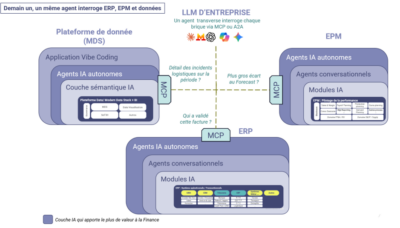
MeltOne integrates the three building blocks that Finance feeds on: ERP, EPM*, and data platforms. This vantage point is clear: AI is arriving stronger and stronger in these solutions, with maturity and business value still varying significantly from one vendor to another (details in AI Impact in Finance: How are your architectures evolving?).
Regarding usage, the gap is clear. According to Deloitte (Finance Trends 2026), 63% of Finance leaders claim to have fully deployed AI, but only 21% see a measurable return. And usage remains modest: according to the 2025 Gartner survey, the top three are knowledge management (49%), accounts payable (37%), and anomaly detection (34%).
Cross-functional agentic solutions dedicated to Finance remain rare: as a support function, it receives little AI budget.
Key takeaway: in 2026, AI is everywhere in discourse and still rare in Finance processes. No one has gained a ten-year lead.
The building blocks of the vision: agents that act… and talk to each other
The autonomous agent: from analysis to action
An autonomous agent receives an objective, acts on its tools and data, observes the result, and starts again. Ask it for a summary of your P&L: it responds that revenue exceeds the budget by 2.5%, then explains why.
The Pigment Analyst Agent thus produces an actual vs. budget OPEX analysis every morning, in the format you have required. These agents primarily perform analysis today; they will trigger more and more actions tomorrow. Six concrete examples are detailed in AI Agents in EPM: 6 concrete use cases for your teams.
Key takeaway: the agent brings autonomy of analysis to your scope, then, progressively, autonomy of action.
Communication between agents: the end of application boundaries
New protocols, such as MCP*, will increasingly and simply allow an agent to query multiple applications within the same conversation. To the question “What is my largest cost variance compared to the forecast?”, the EPM answers: marketing, +13%. “What is the largest marketing invoice of the month?”: the data platform identifies a large partner trade show in Lyon in March. Note that the post-event analysis indicates a positive ROI. “Who approved it?”: the ERP provides the name. Three systems, one single conversation, and a complementary explanation.
After MCP will come A2A* and other protocols. “Cash flow monitoring,” “closing accelerator,” or “budget challenger” agents will then be able to cover a complete scope: analyze, alert, propose corrections and scenarios where you maintain control.
To learn more about this new mode of communication: AI as a bridge between business and IT
Key takeaway: protocols between agents are progressively erasing the boundaries between your Finance applications.
Obstacle #1: AI is generative, Finance is deterministic
An LLM* does not calculate: it predicts the most probable word. Complete “John is a controller. He is an…” and the model will choose “expert” or “specialist” rather than “platypus,” not by logic, but by statistics. Ask it how much 12,345 × 6,789 is and it might answer with confidence 83,810,312. The correct answer is 83,810,205. On a P&L line, this kind of confidence is costly.
Generative AI excels at writing variance comments or synthesizing feedback from subsidiaries. But Finance needs certainty, not a figure that is 90% correct: the deterministic tool* (EPM, ERP) produces the figure, the AI writes and contextualizes. Details in Can we trust generative AI in Finance?
Plugging a generative AI into an existing process is therefore not enough: each step must be redesigned. This work, often underestimated, explains part of the slowed-down rollouts.
Key takeaway: adapting a process to AI means deciding step by step what belongs to calculation and what belongs to generative output.
Obstacle #2: Context and processes that are written nowhere
If you don’t know how to explain it to the AI, the AI won’t invent it. The reclassification rule that only Laura knows, the adjustment “we always do in March”: all of this lives in people’s heads, not in procedures.
An AI agent* is like a very fast recruit: without anything formalized to show them, they will depend on your case-by-case explanations, and their autonomy will remain theoretical.
Key takeaway: a process that no one has documented cannot be entrusted autonomously to an AI.
Obstacle #3: Data and master data that don’t talk to each other
If the same client has three different codes in the ERP, EPM, and CRM, the AI will not be able to cross-reference data reliably. Yet Finance needs certainty, not a “probably correct” reconciliation.
A Finance Department relies on an average of 8 to 9 data sources. In the EY AI Pulse Survey (December 2024), 67% of leaders say their data infrastructure hinders their AI adoption; on the Finance side, Wolters Kluwer places data preparation at the top of adoption conditions (44%).
AI will help with cleaning, but only partially: defining a common master data set remains a human, and often political, decision.
Key takeaway: AI does not create your data inconsistencies; it reveals and amplifies them.
Obstacle #4: Technical debt, the stowaway
AI must rely on building blocks that support it. However, many companies carry heavy technical debt: aging ERPs, in-house interfaces, Excel files that have become critical. According to Deloitte, 41% of Finance teams starting with AI cite their legacy technologies as a barrier.
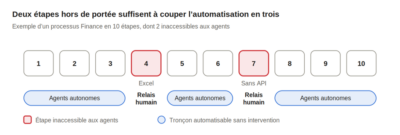
Modernizing is expensive and absorbs AI budgets. Failing to modernize creates zones out of reach for agents: in a 10-step process, if just 2 are inaccessible, the human remains in the loop and the process cannot be redesigned from end to end.
With two steps out of reach, automation is cut into three segments and a human must act as the relay at each break.
Your 2035 trajectory is therefore perhaps already being decided in your 2027 IT master plan.
Key takeaway: two steps inaccessible to agents are enough to break the end-to-end automation of a process.
Obstacle #5: Governance that has not yet designated a responsible party
When an agent proposes a provision, who validates it, and who is accountable for it to the auditors? Without clear rules, AI creates ambiguity regarding responsibility.
According to McKinsey (early 2024), only 18% of organizations have a committee empowered to decide on AI governance. Yet, the AI Act and your internal controls (SOX or equivalent) apply to AI results just like any others (Can we trust generative AI in Finance?).
It is therefore necessary to write down what the agent does alone, what it proposes, and what it never touches. An agent can prepare the closing; it will never sign the representation letter.
Key takeaway: the more autonomous an agent is, the more important it is to know who signs off behind it.
Perspective: thirty years of announced revolutions
Since 1996, every wave was supposed to change everything, and fast: the Internet, the cloud, big data, smartphones, RPA, then generative AI. Each has had strong impacts, but rarely as much as announced, and never everywhere. RPA was supposed to make data entry disappear; many teams mostly learned to maintain robots. The five obstacles described above are the 2026 version of these success conditions.
Key takeaway: each technological wave has kept part of its promises, never all of them, and never everywhere at the same time.
If the obstacles are removed: what can you expect?
If these five subjects are addressed, the vision becomes credible:
-
Less fragmented processes
Because agents talk to each other from one application to another. -
Monitoring weak signals
Beyond what a team can scrutinize. -
A refocus on judgment
Validation, strategy, interpretation.
What impact on Finance teams?
For thirty years, every time-saving gain in Finance has been immediately filled by new analyses: you never come across an idle Finance team. In the Mostly Metrics panel from mid-2025, only 12% of CFOs reduced their workforce thanks to AI, and according to Wolters Kluwer, 85% already consider AI skills important for hiring. Roles centered on the mechanical production of information are shrinking; those centered on its interpretation are flourishing.
| Function | What is shrinking | What is expanding |
| Management control | Manual reruns, report reformatting | Business partnering, strategic scenario planning |
| Accounting / closing | Manual reconciliations, repetitive entries | Agent supervision, exception validation |
| Treasury | Manual cash forecast, entity-by-entity reporting | Continuous forecasting, advising entities |
| FP&A / Group reporting | Formatting, slide construction | Weak signals, decision support |
Key takeaway: AI reduces the mechanical production of information, not the need for Finance.
What AI still won’t do for you
Even in 2035, six skills will remain at the heart of the Finance function:
| Skill | What it means concretely |
| Strategic common sense | Understanding why a figure is “technically correct but strategically absurd” |
| Responsibility | Presenting an investment decision to the board of directors |
| Local context | Knowing that a subsidiary in Germany is not managed like a subsidiary in Brazil |
| Negotiation | Negotiating a budget with a sales director who defends their assumptions |
| Critical thinking | Detecting consistent results based on a wrong starting assumption |
| Trust | Deciding whether or not to trust data whose source is not mastered |
AI increases the scope of business judgment; it does not replace it. And as for negotiating with the sales director, we are not even sure it would want to.
Key takeaway and anticipation: is the vision attainable for you?
Finance in 2035 will be more focused: it will have delegated production to machines and kept interpretation, judgment, and decision-making. To measure your distance from this vision, three questions:
| Question to ask yourself | What we recommend |
| Where is my teams’ time going? | Honestly map the production share and the analysis share |
| What is the quality of my data? | This is the true prerequisite, before any tool |
| How should I train my teams? | Not on tools, but on supervising and challenging autonomous systems |
To precisely locate your organization, we offer the AI Maturity Diagnostic: where does your company stand?. In 15 minutes, it evaluates your AI maturity across six key dimensions: enough to measure your starting point and know which project to start with.
Key takeaway: the question is not whether Finance 2035 will arrive, but how fast it will arrive in your organization.
In summary: a compelling vision, provided the ground is prepared
The 2035 vision outlined by prospective studies is not a mirage, but it describes a destination, not your itinerary. Between the two, five projects: separating calculation and generative tasks, formalizing your processes, making your data reliable, reducing your technical debt, and clarifying who validates what. They won’t make the headlines of any trade show. Yet they are the ones that will decide if your Finance in 2035 looks like the brochure or like that of 2026, with an extra chatbot.
Book an appointment
Let’s discuss your project and discover how MeltOne can transform your challenges into concrete and effective solutions.

Glossary
: an open protocol, launched by Google in 2025, which allows AI agents from different platforms to discover each other, exchange information, and distribute tasks. It complements MCP: MCP connects an agent to applications and data, A2A connects agents to each other.
a program built around one or more LLMs, specialized in a business task, capable of chaining actions and interacting with other tools.
a calculation whose result is always identical for the same input data, as opposed to a probabilistic generation like an LLM.
the set of aging systems, custom developments, and accumulated workarounds that slow down any evolution of the information system.
performance management solutions (budget, forecasting, consolidation, reporting).
a language model trained on immense volumes of text, which predicts the most probable sequence of words in a given context.
a standard protocol that allows an LLM or an agent to query an application (ERP, EPM, data platform) securely, without heavy development.
FAQ
According to major prospective studies, it will be a Finance where autonomous AI agents produce budgets, reports, and anomaly analyses, while teams focus on validation, interpretation, and decision-making. This vision, however, assumes reliable data, formalized processes, and systems accessible to agents.
Five obstacles come up most often: the probabilistic nature of generative AI versus Finance’s need for certainty, undocumented processes and management rules, inconsistent data and master data between systems, technical debt that leaves steps out of reach for agents, and governance that has not yet defined who validates what the AI produces.
In the short term, very few: in the mid-2025 Mostly Metrics panel, only 12% of CFOs reduced their workforce thanks to AI. In the medium term, teams should reconfigure: less mechanical production of information, more analysis, agent supervision, and advisory.
Start with three questions: where is your teams’ time really going, what is the quality of your data, and how are you training your teams to supervise autonomous systems. Then compare your answers to the five obstacles described in this article.
Start with the native AI features of tools already in place (EPM, ERP, data platform), on a non-critical process, alongside a data quality and process documentation project.